Showing posts with label Technology. Show all posts

Thursday, March 31, 2016

The Passive Aggressive House

Modern home building designs are beginning to focus on ways to make homes as energy efficient as possible, from better insulation, to thermal pumps, low flow toilets, solar generators.  These innovations are doing wonders to reduce humanity's impact on the environment, yet they could go further.  Humans are the weak link in home designs, with this realization Smart Home Innovation and Technology Tomorrow and Yesterday (SHITTaY) has come out with a complete product portfolio for creating the very first passive aggressive house.  The passive aggressive house is a wondrous convergence of machine learning, smart sensors, and proprietary technologies, working together to guide residents to a more sustainable life-style.  Each door and window has a sensor noting when the door was opened and the ability to ask itself "did someone really need to leave me open for that long? (I mean they're wasting all of this power trying to heat the outside)"  if the answer is that the door or window should have been closed sooner, the passive aggressive house will politely leave a sticky note on the offending door the next day, reminding the user how much energy they wasted.  Light-bulbs have similar concerns, should they have been run as long as they were, could the user have gone to a brighter spot in the house? if power was wasted users will get a snarky text, several hours or days after the offending action, asking the home owner to be smarter about when they use a light.

The wonders and innovation of SHITTaY don't stop with energy management, the passive aggressive house is deeply concerned about your health.  Networking with smart health and activity monitors, the passive aggressive house knows how much exercise you have done in the past 24 hours and will comment on your snack selections accordingly.  Did you miss your step goal for the day? Not a problem the passive aggressive house will leave judgy messages on your refrigerator's smart display custom tailored to your snack selection.  And if the house feels you really should eat a healthier snack it will push your chocolate eclairs to the very back of the fridge and let them rot there.

Developers at SHITTaY are working tirelessly to provide more natural language interface with the passive aggressive house.  Currently the system is limited to text based interaction, but in the near future the company hopes to integrate actual spoken interface, with voice options including, Fran Drescher from the Nanny, Gilbert Godfrey, your annoying ex, and if research goes well a modulated version of the user's voice from when they were going through puberty and having their voice crack.

The tomorrow's of tomorrow are that much more exciting thank's to the research from the SHITTaY team.

Happy April 1st everyone.


Tuesday, March 22, 2016

Distributed Servers of Tomorrow*

One of the major challenges facing modern internet infrastructure is the energy required to actively cool the laundry list of thermally inefficient micro-processors.  The majority of server farms are so concerned with keeping their infrastructure cool without spending too much money on cooling.  A solution that industry analysts  have been investigating in and investing in, has been air cooled servers, where the server is more directly cooled by the ambient environment, as opposed to having an intermediary air conditioning system.  These air cooled servers have come in a variety of shapes and sizes, and I would like to suggest one more,
Street Lights (I'm not kidding)
Streets lights have the potential to serve as a fantastic platform for distributed computing infrastructure, they are ubiquitous in the world's communities, there is a decent amount of un/under-used surface area for mounting, and as lighting infrastructure moves towards LEDs there is already an inbuilt AC/DC converter.  At the current time the idea is relatively vague, I readily acknowledge that, as the characteristic constraints are hard to pin down.  Ideally these smarter street lights would be connected to a robust internet infrastructure at the local level.  Similar to how server farms have fungible racks of individual server elements, easily added or swapped by a technician.  As Moore's law has begun to slow, at least when it comes to density increases of transistors (I honestly haven't kept good track on actual cost per transistor) this infrastructure can be built up for more long term planning

Potential markets include, municipal governments trying to provide their own localized equivalent to larger online cloud services, local ISPs minimizing their concentration of servers, cable companies/Netflix and other video on demand service providers where last mile delivery concerns are legitimate, and honestly who knows who else.
*(this is a quick and dirty post for the moment, I will do follow up later, my schedule has gotten rather crazy, but I really like this idea March 22, 2016)

A follow up post will have notes on a starting template for a streetlight system intended to promote a hybrid of air cooled servers, battery storage infrastructure to keep things going, and for snowier climbs who knows maybe a heat pump to melt snow around the server.


Monday, November 16, 2015

Modular Home Lighting

I meant to write this post awhile ago, and the ideas are a little disjoint, but I would like to get something out there.

Home lighting in developing countries is a huge economic bottleneck, too many households need to focus on solutions that are low cost in the short term, even though the long term costs are much higher, things like candles, kerosene lamps, or battery powered flashlights.  Any number of NGOs and for profits have worked to develop a range of lighting technologies that will help make the home lives of their users better.  One potentially new concept to promote these lighting technologies is designing a product that can be equally at home serving as the very first electric light-source that person has ever used or as the lighting solution of a modern home.  This can be done by rethinking the LED lighting solution, the vast majority of home LED solutions take advantage of the 100+ year old Edison screw design, this makes sense if you are utilizing older infrastructure, but we are in an era where design rules are changing and there are new connection standards that can make more sense, for example the USB 3.1 C standard.  This standard will soon be ubiquitous across almost the entire planet, and unlike the Edison screw, the voltage and amperage characteristics will be equally consistent from nation to nation.  Engineers could work to create lighting elements that distribute power via USB cables and connections types, and to avoid overloading the power distribution capabilities of the cables, bulbs could be designed to include simple communication protocols that would warn users of low power, excessive draw, etc...

11/16/15 my brain is a little disjoint right now but I wanted to get this idea down. Broad strokes, create an open standard that uses a smart connection type, it doesn't have to be USB 3.1C, but honestly it makes the most sense with that hole 100 watts of power transfer range and what not.  Lighting modules don't need to be exactly the same, but they should have some minimums, shared micro-controller standards, simple and standardized power requirements, easy thermal management, basically if lighting unit A is next to B in normal operating temps, they should stay fine, without any external cooling system, a way for bulbs to efficiently distribute power across bulbs, think femto electrical grids.

The entire rational of this design is that if a community invests in this lighting system, as money becomes more available they can improve their solution, going from small lamps to more traditional overhead lights, all while up-cycling the original components of the small lamp.

11/20/15
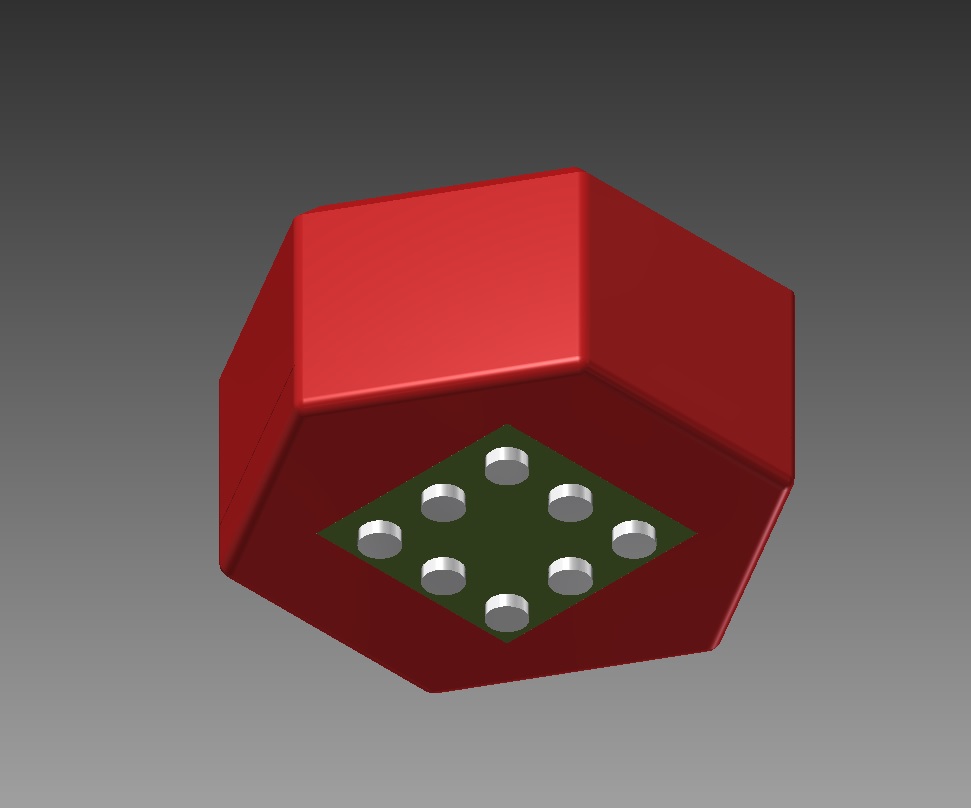
LED bottom
I finally made a proper initial render of what this lighting system could look like.  Both as a single light source and grouped together.  The 8 points on the bottom of the Sub lighting element are one approach to the lighting systems power and communication contacts, with a similar chip element to what is found in the thunderbolt connector type (found in devices like the iPhone) it won't matter which way the lighting element is plugged into its power supply, the lights will work)  On the top you have 7 LEDs they will provide light as well as a means of diagnoses, depending on how many LEDs are illuminated and in what pattern, users will have a means of determining where power issues are occurring, when a module is nearing the end of its life, or other information.  Aside from the full on and full off values, the bulb could potentially have over points of data that could be communicated, assuming you don't worry about rotational symmetry.
LED top.
 
As I refine this idea I can add more details, as well as better models.  The critical question is maximizing functionality while keeping per unit costs as low as possible.  Additional questions on thermal performance of the bulb configuration are worth investigating.
Multiple lighting elements grouped together/


Wednesday, August 12, 2015

Embedding Server Farms where the Power is

When Google or Microsoft want to build a server farm they do their best to build their facilities as close to major energy sources as possible.  The logic behind building their server farms close to energy sources is relatively simple the power is cheapest closest to the source.  Both companies have stated sustainability goals, Google to have all of its power produced by renewable energy sources and Microsoft to become carbon neutral, these sustainability goals, combined with our society's ravenous desire for cloud based services mean that unique solutions for powering server farms will become necessary as time goes on.  
Currently the majority of server farms are massive facilities covering thousands of square feet, what I would like to suggest is a complimentary server farm design that is intended to work with more distributed energy sources.  Instead of massive facilities organizations could invest in smaller systems designed to be installed right next to large scale wind turbines and solar arrays.  Under normal operations the distributed servers would operate at some baseline of data processing, when surplus power is being produced the servers would do scale up how much data they would crunch. 
These servers would most likely make the most sense serving as supplemental archival storage capacity and large scale data crunching where the time the processing completion time is more flexible.  The utilization of this capacity could be implimented in a range of ways, the servers could be owned out right by either cloud service providers, the power producer, or a 3rd party owner operator.  
Hopefully these smaller server arrays would also benefit from increased surface area, said increased surface area would mean more space for hot air to escape, assuming solar gain was not excessive.

Note to self add links for reference.

Thursday, July 23, 2015

The FreshStart Phone

A few days ago a friend of mine texted me asking about how hard it would be to embed solar panels in a low cost cellphone, so that individuals who for whatever reason were trying to get established, would have some way to communicate with their healthcare provider, parole officer, who ever they needed to reach out to to get back on their feet.  The core sentiment is an excellent one, provide a resource for those who are at the greatest risk to engage with society, my primary point of feedback was the power output of the solar panel.  Even under the best circumstances the available surface area of a cellphone would have a hard time collecting enough sunlight to conveniently charge a cellphone.  (I may do the math showing this later, but for the moment I am just going to keep the work conceptual)
Just because a cellphone would have a hard time being charged by sunlight does not mean we as a society couldn't create a device that would be truly useful to those less enfranchised.
Whatever design that is eventually developed it will need to meet a rather challenging list of constraints.  The design suggestions I am putting forth below are just one way a product could be designed to meet a user's needs but I feel it would represent what individuals  might desire in their smart device.  My temporary title for this phone is the FreshStart, if someone in marketing wants to change it, great, I never said I was great at naming things.

The biggest limiting factor is cost, no matter how you want to slice it the primary customers of our starter phone are not the end users, but organizations that need to be able to buy hundreds, if not thousands of devices without destroying their budget. While I have no idea how much per unit either the governments of the world or non-profits would be willing to go, I am going to assume that these phones are being distributed in countries like the US and as such a maximum price of $50 is far from unreasonable.  Current Nokia feature phones cost something like $30 so it shouldn't be that unreasonable to keep the dollar cost of the device close to that.

After cost comes reliability, the device needs to be physically tough and have a very high endurance.  Users may not be guaranteed the opportunity to charge their phone every day and so the battery capacity should reflect the need for going several days without charging.

Close after reliability is attractiveness of the device, users need to feel like the phone they are getting is something important and worth holding onto, it may be free to them, but it should also be something that they value for more than the phone calls.

So far I am reasonably describing currently available feature phones, many now have very excellent run times, so long as they are only used for calls and texting they can work for days. Personally I enjoy the simple look of the Nokia style brick phones (this could be a result of early 2000's nostalgia.)  What would be a distinguishing characteristic of the design is integrating the charger, the majority of phones require you to have a second piece of hardware to charge your phone.  By integrating  the charger you are reducing the number of things someone has to keep track of.  The FreshStart's back would have a simple two prong A/C connector that would allow the device to be directly plugged into a wall  outlet.  To compliment the A/C adapter and to acknowledge the fact that individuals are mobile and may not have a long period of time near an outlet, for example the time it takes for them to finish their coffee, the FreshStart would have part of its battery capacity be a non-removable high endurance rapid charging element, either an ultra-capacitor or an optimized breed of battery that I can't think of right now.  This batter would be intended to charge in under 2 minutes while providing enough energy for ten times or more run time, ideally several hours of use.

Additional features that would be nice but not required, built in USB ports to allow other devices to charge while the phone itself charges, a USB plug to allow the use of charging ports that are now showing up in cities, a flashlight, an E-Ink display.

As of now this is as far as I've gotten with the FreshStart's concept, when I get back to my desktop with CADsoftware I will try to create a 3-D render.


some follow up links, here is a case for the Iphone 5 that has the charger in built as suggested http://www.amazon.com/Prong-PocketPlug-Case-Protective-built/dp/B00F0X1JUC
 and here is where I got the Nokia price point
http://www.pcworld.com/article/2865184/microsofts-29-nokia-215-is-a-smarter-feature-phone-for-the-masses.html