Showing posts with label Sustainability. Show all posts

Wednesday, September 4, 2019

Growing the Growing Season

Nov 3, 2024
Sarah Bishop looks anxiously out at her old cornfields.  For the first time in almost 100 years, the view has had a dramatic change.  Instead of bare ground and debris from the corn harvest, there is row after row of silver mirrored tubes and a faint hint of green.  Sarah is one of the first large scale beta-testers of Smart Farms' brand new Winter Green Bioreactors.  If everything works out as Smart Farms has advertised Sarah will be able to produce enough bio-diesel to power all of her farm and maybe even sell some fuel to neighbors.  If something goes wrong Sarah will have missed her chance to lock in fuel prices for next year and could take a huge hit on the incredibly volatile oil market.

"I still can't believe Sachin (Gupta, Smart Farms' CEO) talked me into this.  Lots of my neighbors think I'm crazy to try, but my kids are getting older and I want them to know that their mom took the chance to keep the farm in the family."

For so many American farmers facing the challenges of climate change, Sarah knows that business, as usual, ended 4 years ago and now she is ready to be bold.  Sachin Gupta is the mastermind of this bold innovation in the algae biofuel market.  "For people like Sarah winter on the farm is a lost opportunity, cold dark days mean you have 4 months where you are just anxiously hoping that the next growing season will work out.  Our team wanted to create something that would help farmers become more self-sufficient while lowering emissions."  

To meet the goal of promoting farmer's self-reliance Sachin's team has developed a new type of bio-reactor.  Using a deceptively simple-looking collection of nested inflatable tubes the Winter Green Bioreactor helps to create a self-regulating algae growth chamber that helps convert sunlight and carbon dioxide into useful biofuel.  The outer tube helps to concentrate weaker winter sunlight onto a collection of tubes nested inside where the algae can grow.  By using adaptive materials and clever use of insulation the Winter Green Bioreactor will help keep the algae at just the right temperature to grow.  

Cutaway view of the Winter Green Bioreactor


Dotted among the silver tubes of Winter Green are non-descript boxes covered in solar panels.  These boxes are another part of the secret sauce of the system.  They help to move the water and air that the algae need to grow.  In addition to the pumps and circulation system, the boxes will automatically filter out surplus algae.

"That was one of our biggest challenges was training the filter mechanisms.  If you take out too much algae you're wasting sunlight, too little and you start running out of nutrients slowing growth"

If things go according to plan, fuel from farms like Sarah's will be producing low carbon fuel for less than $2/gallon.  


Follow up 
Jan 12, 2025

Sarah looks much happier now, algae growth has gone better than expected.  Two weeks after the original article was published a neighboring dairy farm reached out to Sarah and the other Beta Testers.  It has been a win-win for both communities, for the dairy farm they no longer need to worry about too much manure leaching into the groundwater, for Sarah, the algae on her farm have plenty of nutrients to grow as fast as the sun will let them.  

"I'm pretty happy, we already have enough fuel to power all of our equipment for the next growing season and we have six more weeks to hopefully make enough for the Johnsons next door"

*welcome back to the present

This idea originally came about from my article on Agrivoltaics in farming, trying to imagine other uses for the agrivoltaic structure during the winter months when you aren't growing.  Originally I was thinking that you would hang special algae growth bags, after a collection of random thoughts I cane to the concept above.

Some technical stuff

Growing algae is a balancing act of sufficient nutrients, sunlight, and temperature.  The idea of having nested inflatable bags I believe could solve several of those.  The outer tube would help to regulate the interior temperature as well as provide the structure necessary for the reflector elements to focus sunlight.  For most algae the preferred temperature of growth is between 16 C and 30 C, there are species who can happily grow at higher or lower temperatures.  

I intentionally didn't include an actual scaling value in the image because, well I'm just not qualified at the moment to have a firm value, that being said, almost every article I've read indicates that anything deeper than 3-4 inches for a thick algae growth is a waste as there isn't sufficient sunlight,  so I would pretend that the center tube has only about 3 inches between the surface and the nutrient dispersal tube in the middle.

The $2/gallon value was inspired by a biofuel company's claim that their system could produce fuel at $1.27 gallon (assuming you are producing 8,000 gallons per year per hectare (1 hectare (10,000sq meters)  = 2.47 acres))).  I have no idea how the economics would work for a system trying to grow algae during the darkest parts of the year, but I wanted a plausible adjacent number.  

The best-case scenario for these seasonal inflatable bioreactors is for people like Sarah.  People who want to produce their fuel for super local consumption.  If the plan is to export the biofuel hundreds of miles the environment would probably be better off having the fuel made in places where year-round production was possible.  That being said I do think a part of our future will include things like algae being grown incredibly locally, it wouldn't be too crazy to imagine homes having bio-walls producing small quantities of biofuel year-round, so on those days where there hasn't been enough sun or wind to charge the batteries there is a back up energy source.

Further Reading 


As always questions and feedback are welcome


Sunday, May 5, 2019

Electric Airplanes Continued

Some follow up thoughts on the post "Automatic Refueling..." where we looked into a possible path for extending the range of electric aircraft. 

Battery energy density.  While there is no disputing that electric airplanes will need incredibly high energy densities to allow for sufficient range to be super appealing to consumers (even with range extending support craft).  One thing to keep in mind is that the calculations for energy density are based on the assumption that the batteries are only storing power and doing nothing for the structure of the vehcicle.  If researchers are able to develop a storage mechanism that can improve structural integrity, that would be just fantastic.  While structural batteries would be really cool I don't want to be so naive as to assume that a structural battery would have the same energy density as those that purely store energy.  As they could not readily be removed from the body of the airplane structural batteries would need to have incredibly long life expectancies, most lithium ion batteries will lose something along the lines of 20+% of their energy density after a few thousand full charge discharge cycles.  The Physics World article "Structural supercapacitors take a load on" shows that developments are already underway.

Assistive Take Off and Landing.  While midflight recharging is cool, to ensure maximum range for your electric plane it may be a good idea to have assisted take off and landing, similar to what was described in "Giving Planes an Electric Boost".

Modes of recharging mid flight:  In "Automatic Refueling..." we talked about the need for relatively rapid rates of energy transfer between the primary electric airplane and the support vehicle.  If only one support vehicle at a time is able to transfer power there is a concern as to how quickly it can move that power from one unit to another.  As of now it is hard to say how support vehicles and the primary electric plane will dock with eachother and how frequently, in principal there should be no difference with having one support vehicle or many docking at various times to move energy.  In practice it would most likely be more complicated, if a physical connection is used to transfer power, each docking vehicle will require some degree of additional complexity and wiring.  On the other hand if energy is transferred wirelessly there are concerns about interference in navigation tools and the weight of the reciever, as well as transmission range (basically this is a really hard engineering problem)

Mid-Flight Passenger Transfer  In the future scenario, it was suggested that support aircraft might be designed to carry a small number of passengers.  One big concern for this idea to work is ensuring the safe transfer of passengers mid flight.  For passengers to be able to get into a small transfer vehicle and safely reach their destination there would need to be a way of ensuring that consumers could avoid the disruption of turbulence without them being excessivley jostled by the air all without flying to far from their destination.  One option might be to simply have a clause on every ticket saying that for destinations that are not being visited by the primary electric vehicle, they will only guarntee that they will get you to the closest support vehicl landing pad that they can safely move you to.


Those are my thoughts as of now, if you have any questions or insights of your own please feel free to add them

I will add on that I have been trying to get details about the ranges and capabilities of hydrogen fuel cell airplanes, at this time I can't get solid enough info to say much.  From my perspective I will say I'm more ok with electric aircraft using fuelcell tech than cars, my reasoning is that for electric cars our biggest concern is per person affordability and for ground based vehicles current battery tech is on a good enough trajectory.  The economics of the airline industry are a closer match to the particular characteristics of hydrogen fuelcell tech (as I understand things).

Tuesday, March 19, 2019

Preliminary Investigation on Greenhouse gas sequestration via Liquid Air Energy Storage

Global innovations in renewable energy give hope that humans will be able to curtail greenhouse gas emissions and slowly mitigate the impact of human caused climate change.  While innovations in renewable energy are significant the majority of innovations do nothing to offset warming that results from surplus greenhouse gases that are already in the atmosphere.  So called "negative emissions" technologies may serve as a way to reduce the volume of greenhouse gases dispersed in the atmosphere.  There are 6 major technologies that can be used to help remove surplus carbon dioxide they are reforrestation, bioenergy with carbon capture and storage, soil carbon, biochar, enhanced weathering, and direct air capture.  Each of these technologies should be considered as part of a long term solution to mitigating climate change, this paper will focus on means of enhancing Direct Air Capture technologies. 

Direct Air Capture is a very clean description of the technology, broadly speaking researchers are developing various means of blowing air across a capture medium, as the air flows past the capture medium grabs carbon-dioxide molecules.  Once the capture medium becomes saturated a second process will be used to extract that carbon dioxide where it can be used to help plants grow in a greenhouse, or to carbonate a beverage, or with an altruistic enough buyer that carbon dioxide can be buried underground.  As of the writing of this article estimates for Direct Air Capture put the cost of removing a metric ton of carbon dioxide from the atmosphere at somewhere between $250-$800 not a small cost.  To put this in perspective the United States produces something like 6.5 billion metric ton of carbon dioxide equivalent green house gases*, this means that to capture American greenhouse emissions you would need to spend between 1.625 and 5.2  trillion** dollars per year, to remove those emissions (for perspective the American economy in 2017 was about $19.5 trillion).  Part of the reason it costs so much to capture the carbon dioxide is a tremendous amount of energy is being used to do one thing, capture the carbon dioxide, of the publicly available information on direct air capture technologies, no firm indicates that they are doing anything but capture carbon from ambient air.  What these technologies need is a way to concentrate the air that they are extracting carbon dioxide from.

Liquid Air Energy Storage(LAES) is a relatively new entrant to the world of grid energy storage.  Using advanced refrigeration, companies like Highview Power are developing tools to use surplus grid energy to turn air into a liquid.  When electricity prices are low a refrigeration cycle is run on the air around the power storage facility.  This refrigeration process turns the air into a liquid that can be stored in massive cryo-tanks.  As the electric grid goes from a surplus to needing more power, that liquid air is cycled to expand back into its gaseous state, this expansion is used to run a turbine that provides electricity for the grid  (a more in depth explanation can be found here).  What is exciting about liquid air energy storage is that you are already moving the air for useful work, providing an opportunity to create symbiosis between the liquid air and direct air capture.  

There are at least two potential ways where Liquid Air Energy Storage can be used to augment Direct Air Capture.

1.  Add carbon scrubbers at either the beginning or end of the energy cycle.  During either the capture or release phase of the LAES lifecycle the air is run past a carbon capture materials.  This approach allows you to augment an already existing LAES system.  The tradeoff is that the capture medium is going to directly impact your intake/release systems ability to work efficiently.  On intake your intake fans will need to work that much harder to bring in the source air.  On the other end of the cycle where the "exhaust" of regasified air is being released the filter mediums will also be able to take advantage of exiting outflow, but the outflow will be slowed down by the obstruction (this is the same reason why you should clean filters on your computer and AC system)

2.  Capture the carbon dioxide during the refrigeration process.  The nitrogen, oxygen, and carbon dioxide in our atmosphere all of their own temperature for when they turn into a liquid (or solid in the case of carbon dioxide at 1 atmosphere of pressure).  This range of temperatures gives us an opportunity to integrate a way to scrub out the carbon dioxide by capturing it as it changes state from a gas to a solid.  Nitrogen becomes a liquid at −195.79 °C, oxygen liquifies at −182.96 °C, and carbon dioxide sublimates at −78.5 °C.  The relatively high temperature of carbon dioxide's freezing appears to give an opportunity to add a stage to the LAES lifecycle where solid carbon dioxide is scrubbed from the liquid air energy storage before being returned to the atmosphere.  The potential risks of this approach, would include, increased complexity of the refrigeration cycle, as the chamber/stage where the carbon dioxide is removed might not work with standard approaches to making cryo-liquids, and maintenance cost increases.  

At this time there is no way to cleanly model*** how Liquid Air Energy Storage would impact the cost of Direct Air Capture, that being said we can at least estimate how much energy the US would need to store to impact carbon dioxide levels.


So it turns out liquid air systems already filter out the carbon dioxide, this is just an inherrent part of the design, so basically I like this technology.

REGARDLESS we can still look into how much power you would need to store to filter out CO2

According to the wikipedia entry on liquid nitrogen engines, a kilogram of nitrogen stores about 100 watt hours of power.  To make life easier we are going to assume that all liquid air has about the same energy density.

From the table above we see that for every 1625 kilograms of air you liquify, about 1 kilogram of carbon dioxide would be extracted from the atmosphere

that indicates that for every kilogram of carbon dioxide you remove from the atmosphere you would be able to supply the grid with about

1625 kilograms of air - 1 kilogram of carbon dioxide =1624 kilograms of air for power

1624 kilograms *100 Wh/kg= 162,400 watt hours or 162.4 kWhrs

to extract a metric ton of carbon dioxide you would store enough energy to produce 162.4 megawatt hours of power

to extract all American produced carbon dioxide through LAES how many kilowatt hours of power would we need to store?

the US produces 6.5 billion metric tons of carbon dioxide equivalent green house gases of those 6.5 billion metric tons 82% are actuall carbon dioxide  (to make life easier the author is assuming that it isn't possible to capture the remaining 18% of green house gases through air liquification)

This means that the US currently produces 5.33 billion metric tons of CO2

the total energy storage requirement would therefore be

[162,400 kilowatt hours/metric ton of CO2 ]*5.33 billion metric tons of CO2

which works out to 865.6 trillion kilowatt hours of energy stored.  To put things in perspective the US currently consumes 3.7 trillion kilowatt hours of energy.  What is even crazier, the 865.6 trillion kilowatt hours is how much power is being stored, LAES is about 60-75% efficient which would mean the grid would need to produce closer to 1200 trillion kilowatt hours of electric power.

Obviously the United States can't afford to capture its carbon emissions in the way described above, but what if the country decided that we were going to go to 100% renewable energy and we, for some bizarre reason, decided that all power would be first used for carbon capture via liquid air before the energy went to the grid.  How much carbon dioxide could we capture?

3.7 trillion kilowatt hours of energy*(1 metric ton CO2/162400 kilowatt hours)= 22.783 million metric tons of Carbon dioxide

Thoughts and feelings

Honestly when I started this post I was hopeful that the math would indicate that there was a relatively
 affordable technology that was waiting in the wings to make our world more efficient.  The above
calculations are a great way to highlight how complicated the climate change challenge really is.
I still feel that liquid air energy storage should be considered, even if it doesn't filter the atmosphere 
as aggressively as I had hoped.  As of 2017 something like 28% of American green house gas emissions
are from electricity production, smart grid technologies can offset a tremendous amount of emissions.
Large scale grid storage also makes it that much easier for electric cars to be run in a cost effective 
fashion.  As a society we should challenge ourselves to look for solutiosn to the major problems facing 
us.  Fingers crossed that technologies like direct air capture and liquid air energy storage help to make 
our future more sustainable

*an equivalent ton of carbon dioxide is a way for scientists to communicate that while not all greenhouse gases have the same greenhouse effect, they can use this equivalency to communicate what the warming impact is.
** 250 dollars/metric ton *6.5 billion metric tons = $1.625 trillion
     800 dollars/metric ton *6.5 billion metric tons = $5.2 trillion 
(this math assumes all greenhouse gas emissions are carbon dioxide as I am lazy and it gets me within 25% of the actual answer and I wanted this to look clean)
*** for me, I mean I don't doubt if I could get some Direct Air Capture and Liquid Air experts in a room we could figur it out, but that's just not in the cards right now, sorry 'bout that

Monday, March 11, 2019

America's Mountain of imaginary ice

Every day across the Unites States, an army of compressors work tirelessly to keep our food cold and our living spaces comfortable.  On their best days, cooling technologies fade into the background, unobtrusively making life better, it is high time we thought a bit more about the energy used to keep our nation cooled.
Before the invention of modern refrigeration technologies humans would sometimes use giant blocks of ice that had been harvested in the winter to make life more bearable.  What would it look like if we had to keep our civilization cold with one giant block of ice, and how big would that block of ice end up being?
Every year the United States consumes about 3.7 trillion kilowatt hours of electricity.  Of those 3.7 trillion kilowatt hours 697 billion kilowatt hours are used for some kind of cooling or refrigeration (about 19% of the national total (1)).  Right now we have a nicely estimated number based on some federal data from the Energy Information Administration what we need now is a way to turn kilowatt hours into a block of ice.
Making ice is a cool process (bad pun intended) where you remove enough heat from water to cause the water to go from a liquid to a solid, this is called the heat of solidification.  Water has a relatively high heat of solidification, which is helpful as our iceberg would be really massive otherwise.  The size of the iceberg will depend on several assumptions, for this post we are going to do the a rather basic calculation where all of the cooling will come from melting ice into water*.
And now the math....  (feel free to skip to the BIG NUMBER section to see the size of the iceberg)
First we need to make our units as easy as possible to handle, converting kilowatt hours into joules
kWh*J/kWh =

0.697 trillion kilowatt hours * (3.6*10^18 J/trillion kilowatt hours) = 2.51*10^18 J

now to calculate the mass of the ice that would need to be melted to meet our needs

Cooling requirement/Heat of fusion of ice

2.51*10^18 Joules/(333.55 J/1 gram of water) =7.52*10^15 grams

Finally the total volume of the ice

Ice has a density of 0.92 grams/ cm^3
Mass of ice/density = Volume
7.52*10^15 grams/density of ice at 0 degrees C
7.52*10^15 grams/0.92 grams/cm^3  =  8.17*10^15 cubic centimeters
8.17*10^9 cubic meters

Volume of the empire state building =37 million cubic feet
35.3147 cubic feet/cubic meter
Empire State building =1.048 million cubic meters
8.17*10^9 cubic meters* 1 Empire State Building/1.048*10^6 cubic meters = 7800 Empire State Buildings


BIG NUMBER
8.17 billion cubic meters  or the equivalent of about 7800 Empire State buildings of Ice

Hope this was interesting, if you have any questions please feel free to ask, I am attaching a screen grab of the excel file I used to do my calculations, if you would like a copy please let me know.


Sources for information are provided below.


Sources
Wikipedia "Ice storage air conditioning"  big stat: 1 cubic meter of water can store 334 MJ  the equivalent of 93 kWh  Fun fact:  the origianl definition of 1 ton of cooling, meant the total heat energy you would need to cool a 3000 square foot home in Boston (this is fun as I am Boston based)
Wikipedia "Enthalpy of fusion"  1 gram of water requires 333.55 joules to go from liquid to solid or vice versa
EIA (US Energy Information Administration) The United States uses a mix of energy sources
EIA  Use of Electricity 

Main stats (from 2017) Residantial energy consumption was 1.38 trillion kWh (about 37.4 % of all energy demand) for domestic consumption cooling/airconditioining composed 15.4% of energy use  Refrigeration is 7.2% and freezing was 1.6%
Commercial was 1.35 trillion kWh (36.6% of all electricity demand)  Refrigeration was 14%  Space cooling was 10.6%
Industrial was 0.95 trillion kWh (25.7% of all American electricity demand)  Facility heating, ventilation, air conditioning, and cooling is 9.5%  (this is where math would get rather fuzzy)  Process cooling and refrigeration 7.3%

(1)  see attached excel screen grab (core data taken from EIA page Use of Electricity)

* Assumptions include but are not limited to, assuming that the energy needed to melt the ice is only coming from cooling things, and that there is no solar gain

Thursday, February 21, 2019

Improving the stability fo shipping

this idea is heavily inspired by a proposal to make oil tankers more energy efficient by reducing the sloshing of shippoed oil by using air bags to keep the liquid in place.


For large volume mailers like amazon and USPS there is a risk that packages will tumble if not stored correctly, this is part of the reason why amazon sends you a large box with not much inside sometimes,  instead of mailing empty boxes through the full lifecycle, instead have an air sac that would fill into hold packages in place.  For the airbag solution for fuel tankers, a single large bladder is used to fill the entire volume of the tank, which works as the liquid would be all at one level (assuming the tanker was on flat ground).  The packages would be a more complicated affair, the collection of boxes would invariably be uneven, and would therefore require a more complicated airbag system.  At this time it would be difficult to say what the final design would be, but the technologies of softrobotics could be a cool place to start (or maybe I just really like the tech). 

One approach that might be used would be a grid of air bags that would expand themselves to create an inverse of the topology of ther boxes being shipped.  The grid pattern is unlikely to perfectly secure the items being shipped, but it would be better than just a hope and a prayer. 

Thursday, February 7, 2019

Integrating Pykrete and Daytime Blackbody Emitters

During World War 2 a shortage of steel led inventor Geoffrey Pyke to suggest to the British government the development of an ice based carrier to aid in the war effort.  The  carrier was made from simple water ice and deemed too weak to serve as a proper launching platform.  The need for a stronger cheap material to make into a carrier led to the development of what is now called pykrete, ice that has been mixed with sawdust, cheap to manufacturer and much stronger than simple water.  By 1943 government interest waned on the development of the ice carrier as the tide of the war shifted in the favor of the Allies and pykrete became a historic curiosity.  

A big weakness of pykrete as a material for fabrication stems from its need to be kept cold to maintain its strength, while steel and concrete are more expensive they benefit from working in temperatures above freezing.  With research and development into daytime blackbody cooling technologies, pykrete might have its day in the sun at last.  New research into blackbody cooling surface coatings have already acheived materials that according to papers, are affordable to manufacture and provide the ability to cool surfaces by 8.2 degrees C (about 15 degrees F) from ambient air temperature.  By combining these passive coolilng films on the outside of a pykrete structure, it would be conceiveable to create a floating iceberg capable of surviving year round (in the right latituteds).

These permanent ice masses could have tremendous applications at extreme latitudes, providing a working platform for weather stations and communications relays.  The design of the ice platform would be complicated to say the least, it would be unlikely that you could make a year round ice block just by making a cube of pykrete and wrapping it the cooling film.  The corrosive nature of sea water and limited surface area would minimize the benefit of having a cooling surface coating in the first place.  The most likely design (broad strokes) would be a large mass of pykrete, internally permiated with tunnels for refrigerants to be circulated through the system to keep it from melting.  The side of the platform that would be exposed to open air would be covered in a complex topology of cooling fins, designed to maximize the surface area of the system capable of disipating as much heat as possible. 

Realistic use cases:

Long term research station for you know northern scientsits

Radio relay:  create a network of these platforms above the Arctic circle and use them to connect the various parts of Europe, North America, and Asia

Platforms for telescopes  As the North Pole only needs to compete with Santa Clause's workshop with respect to light/radio polution, these pykrete platforms could be used to make a really massive array of radio dishes to get a unique perspective on the galaxy.

(the really real option)
Russian missile launch platforms, why waste a fully fledged submarine when you could make a passive block of ice with a radio receiver awaiting launch codes.


Pros
The artificial land masses could be used, in a small way, to shore up icemasses in the Arctic and Antarctic, their material properties and cooling characteristics could help other ice masses stabalize year round


Cons
Limited range of use.  By requiring such relatively low temperatures to remain structurally sound there would be a relatively small number of regions on the planet where you could make these platforms 

Monday, January 28, 2019

Giving Planes an Electric Boost

The global airline industry is one of the cornerstones of modern society, it is no longer surprising to have family and friends fly halfway across the globe to share the holidays or do business.  Unfortunately this convenience has a dark side with roughly 4% of our civilization's greenhouse gas emissions coming from air travel.   One way to make a plane more efficient is to make it lighter, a more radical approach to making an airplane lighter would be to make the engines smaller.  The amount of energy required to get a passenger airplane airborne is, generally, the most energy intensive part of flying.  What if instead of making planes with 2 - 4 large engines that need to meet all of the energy demands of a full trip, you designed a plane that worked with a range of engines including symbiotic assisted take off robots (SATOR or SATOD if you want to use the term drones instead of robot).

By designing an passenger/cargo aircraft to dock with assisted take off robots you could make the primary engines smaller, by making those engines smaller you enter the potential for a virtuous cycle of design where the lighter engines require less fuel, which gives the option of making the fuel tank smaller, which further reduces the amount of mass that needs to be transported, and less mass translates to lower emissions.  At this time we (okay me the writer, I bet someone with an aerospace engineering background would have some cool ideas) can only speculate as to how this concept would change the design of aircraft, but there are some parameters we can define if we assume our goal is lower emissions.

The SATORs would be electrically powered, (otherwise we aren't really making things more sustainable)  With a relatively short operational period the SATORs would not be endurance athlethes, they would be closer to bobsledders at the beginning of the race, providing a short burst of energy to get things going.
The SATORs would need to be maximally reusable, the designs would need to be robust enough for dozens of take offs and landings each day, this would dictate both the battery design and air frame.  One advantage of the SATOR being robotic is that it will not need to be pressurized and as such this should aid in the overall life expectancy of the units.

Pros of the SATOR idea:  As mentioned previously lower emissions and the other detail a friend pointed out when I suggested to her the idea, quieter take offs.  The smaller main engines working in concert with the relatively quiet electric engines could allow for airplanes to be much quieter.  As she noted this could change where/when airports are allowed to operated

Cons of the SATOR idea:  as the idea is pretty broad the main concern would be the increased complexity that they would add to an already complex industry.  Airplanes would need to be specially designed to used these units ( I assume), additionally there is the worry as to how the returning SATORS would behave when uncoupling from their parent aircraft and returning to their ground station.

Thoughts and feedback welcome

Wednesday, July 27, 2016

Passive Window Cooling Idea

I may be a little obsessed with the Fan Group's research into radiative cooling.  (what can I say, I really hate excessive summer heat).

As the Greater Boston area is in the midst of a rather unpleasant summer heat wave, the mind turns to ways to help cool our human made environments.  (A big thanks to Willis Carrier for inventing modern AC)  While active heat pumping has the advantage of being incredibly fast, it does increase our civilization's energy demands, and until those energy sources are no longer adding greenhouse gasses, we are leaving ourselves in a nasty little feedback loop.  One potential means of increasing how efficiently we cool our homes, would be to create a window unit that passively provides radiative cooling while still allowing light through.  The design would have 3 major parts, the transparent cooling surface, heat pipes, and a small solar panel to power a fan.  After a user puts their cooling panels into place, the houses heat would be transported from the inside through the heat pipes.  To ensure that as much heat is being taken away from the house as possible, a small fan attached to a heat sink, similar to what you would see inside your computer, would blow air as necessary.  Sounds great in theory, but let's try to figure out how useful this idea would be.

Fig 1 On the left a flat panel trying to radiate heat away
on the right, the bumpy pattern points the heat towards space
 Each square meter of radiating material would provide roughly 850 watts of cooling or the equivalent to 2900 BTUs (about half the cooling of what a window unit made for a small room would provide.  This means that for a small room (about 125 square feet), you would need about 2 square meters of cooling surface (I am making a distinction for reasons I will go into later).  Without knowing how heavy all of the elements would be it would be pre-mature to comment on how unwieldy the mass of the system would be, that being said just that amount of area would be hard.  If this magical room had 4 decent sized windows, you would still need each panel to be at least 0.5 m by 1 m (or about 19.75 inches by 39.5 inches, unless this thing is folded up before you open it, not easy to safely place out of your window).  The reason the size of the panel needs to be at least half a meter by a meter, not exactly that size is a matter of how radiative cooling works.  Black body radiators need to be pointed at something colder than they are, in the case of this technology, the cold of space, if the surface of the panel is perfectly smooth, your cooling window is now most likely pointed at your neighbor's house, probably picking up the heat being reflected and or emitted by the neighbor.
 If the panel was to have a bunch of ridges creating a cool 3-D panel, probably a bunch of 45 degree slopes, you are only getting about 70% of the equivalent height of the array.  so now instead of being half a meter by a meter, the panel needs to be 0.5 m x 1.5 meters to get the same effect.  Now home owners have to spend the energy installing these far more massive panels, or putting in way more small panels to get a similar effect.

Fig 2:  Cooling panels to go outside big buildings
We are quickly running into a design that seems less and less appealing, which is what I came to realize, as excited as I am about passive window cooling units, they start seeming pretty silly as a primary means of cooling a home.  Small seasonal units might still find a niche market, for home owners who want to minimize the amount of work their actual AC system needs to work, but the real market for passive cooling technologies would most likely come from larger businesses that want seasonal cooling capacity.  Instead of designing a window unit that needs to be small and light enough for a home owner to put in, engineers should focus their efforts on creating two types of passive cooling installations, seasonal and permanent.  Designing a building to permanently have passive cooling systems on the outside, would make the most sense as to be customized for the building's use case (read too difficult to properly be analyzed in this blog), the seasonal solution is a bit easier (as I am looking at the problem from my perspective).  Imagine giant shutter looking structures. some intended to allow light in, others to maximize cooling.  Businesses and organizations who require massive amounts of air-conditioning could lease these panels and have them place around their building at the beginning of the summer, drastically offsetting how much energy the would need to devote to air-conditioning.  The challenge for this use case is the business atmosphere, realistically without either utility or government mandates to minimize peak energy consumption during the summer months, it could be difficult to inspire wide spread adoption of this kind of cooling technology.  If society had the will power to invest in more passive cooling technologies, there would be less demand for peaking power plants (the most expensive types of electrical generators), reducing the overall cost of energy, which is generally a good thing.

A quick note on the passive window unit.  While I don't think it makes sense for most American consumers, I do think the idea has merit in regions where power is less reliable or more expensive.

The idea behind this post is I generally only quickly outline an idea or act like I've seen the future and it must include my "brilliant" solution, I wanted to convey, at least in a small way, how I iterate through ideas and what problems I try to consider.  I hope this provides a small sense on how I try to create solutions to problems.

As always, questions, comments, feed back what-have-you always welcome.

Wednesday, July 13, 2016

Augmented Reality and Getting Rid of Fences

Or How Technology Could Destroy the Cowboy

This idea is several years old, it lay dormant, until the joy of Pokemon Go brought it back.  Currently farmers who have live stock will often need to enclose their property with many miles of barbed wire or electric fencing to control where their animals are at a given time.  In an era with ever cheaper augmented reality technologies it could soon be possible to create smart goggles for animals.  Ok, I bet you're thinking, this is crazy, but bear with me.  If I have a large herd of cattle, I can equip them all with special goggles, that would allow ranchers to tell the cow should be at any time, all without herding the animal.
The goggles would provide a visual overlay onto a given animal's field of view, and at any time the cow, sheep, goat, etc... tries going into an area where a farmer doesn't want them, the goggles would provide a visual cue to make them want to go some other direction.  If the visual cue isn't enough, a system similar to a dog's shock collar would be activated to provide negative reinforcement.  The technology could go even further, scientists are developing bio-medical sensors to look for health indicators, the goggle system could actively report the health and location of all of a farmer's cattle, as time goes on the system would even include diet control, so when a cow goes up to its feed pen, the machine ensures that any nutritional gaps are filled.  Now the cost of this technology would need to be low, but in theory secondary cost savings could raise what that acceptable price would be.  First the reduced need for fence maintenance, probably a good thing, theft prevention, now the cows will only look for people that are authorized to do anything with the animal, if something isn't authorized, well it will look scary and the cow would go the other direction.  Harder to quantify now, but my gut says it might be useful, reducing ecological where wear and tear, as farmers no longer need to directly watch their herd, the computer can keep them grazing over a much more dynamic landscape, reducing the negative impacts of too many cows in too close an area over a given time.

(this article is now making me want to think more about smart farming, I'll try to keep coming up with additional ideas, and make a mega post later on)

As per usual, please feel free to comment share, feedback is always appreciated.

Edit July 14 2016
Another thought occurs, if this technology is affordable enough to equip the world's cattle with, we could start adding it to endangered mega-fauna (read elephants, rhinos, pandas)  There are stories of communities in Sub-Sahara Africa using lines of bee colonies to dissuade local elephants from entering into human farm land.  With augmented reality tech for wildlife, such needs could be reduced.  Secondary benefits could include the ability to monitor overall herd health, and serve as a way to provide evidence against poachers.  Another potential benefit for those in places like Alaska, young bears who haven't quite learned that entering human controlled spaces could be more actively convinced to not return to places with people, and when they see people in their territory, the human could look scarier.  (crap I should have been lazy and made this into a brand new post)

Thursday, February 4, 2016

Energy Audits for Rental Properties

This idea is on the vaguer end of the spectrum (shocking for a guy like me), the vagueness stems from not having a deep enough concept of how policies are rated, anyway enough of me covering my ass.

One of the challenges I have had while being a renter in the Greater Boston area, is the lack of information when it comes to energy costs.  As someone who likes to at least pretend that they care about the environment, I wish that when I looked at an apartment there was a fact sheet that included a rough grading of how energy efficient the apartment was.  Ideally, for me, this grade would focus on a few critical factors, how much energy does it take to heat or cool a given square footage, how much energy transferred between the home and the outside world (basically how good is the insulation), and what are the base line electricity demands of the appliances in the home (read how efficient is the apartment's refrigerator/ other appliances that came with the place).  Something like these variables would be translated into a letter grade, if the letter grade is too low the property owner would be required to invest in energy efficiency improvements.

Implementation would be challenging to say the least, in cities with a large volume of rental properties, doing the assessments could get rather costly.  To help pay for inspections, utility companies could work with the community to promote analysis, in this way all parties can win, the utility can minimize energy used by residencies, land lords would have a way to promote their properties, and renters would be able to factor in energy costs with their decision to rent a particular property.  Ideally these assessments would occur on a regular cycle, the length of said cycle is hard to know, my personal starting suggestion would be something like this, no property can have gone for more than 10 years with out an inspection, if said property is found to have been rented to individuals there would be legal consequences for the property owner.  Preferably every 5 years there would be an assessment, this should ensure that upkeep doesn't fall too far behind.

Monday, January 25, 2016

Salting Sidewalks Sustainably

This idea was partially inspired by my friend Forrest's suggestion to develop footpaths that could be put on side walks to help mitigate slipping.  There was some back and forth and tangential thought followed by tangential thought an idea occurred to me.  Researchers did a study where they used pickle brine to remove snow build up.  I am betting that there isn't enough pickle brine to successfully remove all the snow on America's highways, it does inspire a thought.  A water bottling company could produce desalinated water, preferably using green energy, and the high salinity water produced as a by-product of the desalination process could be used to help melt snow.  The fact that the water is bottled would allow us to avoid wasting groundwater supplies on bottled water shipped around.  The real challenge is finding a location for the desalination plant that meets the requirements of relatively affordable green energy in the region, while also being near enough snow fall, that the cost of shipping the salty water isn't prohibitive.  States north of Pennsylvania on the East coast and the entirety of the west coast have the potential to utilize this concept.

Wednesday, December 9, 2015

Flat packing the critical parts of a home

Providing sustainable living arrangements for a burgeoning global population is a tough proposition. Engineers around the world are asking themselves how do you bring the most benefit to the world without draining its resources?  Housing has an amazing potential to impact the overall level of sustainability of a region, the more efficient a community is at using its local resources the lower their ecological footprint.  One way to make homes more efficient is to provide home makers with an efficient starting point for construction, to that end designers could work to create construction elements to serve as that starting point.  It is my opinion that these starting points should be the kitchen and/or the bathroom.  The rational for these rooms serving as the starting point stems from the additional mechanical complexity required for rooms that have plumbing.  If someone building a home had a wall that contained all of the necessary elements for moving water, electricity and if needed natural gas, the cost of building the home should be drastically reduced.  At this point I have an under constrained design space, which can be rather overwhelming as you start to consider so many different possibilities.

Possibility 1)  A really bare bones system with connection points for water (hot and cold), electricity, and drainage.  This provides a strong starting point that you could attach either a kitchen sink or elements from a bathroom.  Possibly the cheapest of the concepts.

Possibility 2) A total of 3 wall segments folded into a single flat packed element that allows for power and water distribution between the 3 walls, this would allow for builders to have a very easy starting point, that so long as it was unfolded along specified configurations, would also be rather stable, even before the rest of the house was completed.

Possibility 3)  Go more high tech and integrate electrical storage into the wall elements, helping to smooth the home's energy demands, varying tiers could be designed for different budgets,   The intro model ships with a 200 watt solar array and embedded into the walls enough energy storage capacity for 1 kilowatt hour of electricity.  Not a large amount of energy, but it would allow for the lights to stay on during power outages.  Higher tiers could store more electricity and provide for larger electrical draws.

Possibility 3 b)  Integrate additional lighting fixtures, considering modern LEDs are expected to have life expediencies of around almost 20 years, with some clever design work you could make a home where the lights wouldn't need to be changed for generations.  (there are some trade offs that may make this a terrible idea, but hey, we're talking theoreticals now)

The rational behind designing individual wall elements with all of this integrated equipment as opposed to creating a flat pack home stems from the belief that this technology should be used to empower local communities, not mitigate the benefits of local labor and resources.  With these panels, home designers could choose to make something akin to an Earthship, a more traditional American Cape-Cod, or a home design whose name I don't know.  Ideally such designs should be open source or at the very least, like shipping containers, there should be standardized dimensions and design constraints to ensure safety.  Examples could include making sure the wiring and socket elements can accommodate the various AC standards found around the world.

Monday, November 16, 2015

Modular Home Lighting

I meant to write this post awhile ago, and the ideas are a little disjoint, but I would like to get something out there.

Home lighting in developing countries is a huge economic bottleneck, too many households need to focus on solutions that are low cost in the short term, even though the long term costs are much higher, things like candles, kerosene lamps, or battery powered flashlights.  Any number of NGOs and for profits have worked to develop a range of lighting technologies that will help make the home lives of their users better.  One potentially new concept to promote these lighting technologies is designing a product that can be equally at home serving as the very first electric light-source that person has ever used or as the lighting solution of a modern home.  This can be done by rethinking the LED lighting solution, the vast majority of home LED solutions take advantage of the 100+ year old Edison screw design, this makes sense if you are utilizing older infrastructure, but we are in an era where design rules are changing and there are new connection standards that can make more sense, for example the USB 3.1 C standard.  This standard will soon be ubiquitous across almost the entire planet, and unlike the Edison screw, the voltage and amperage characteristics will be equally consistent from nation to nation.  Engineers could work to create lighting elements that distribute power via USB cables and connections types, and to avoid overloading the power distribution capabilities of the cables, bulbs could be designed to include simple communication protocols that would warn users of low power, excessive draw, etc...

11/16/15 my brain is a little disjoint right now but I wanted to get this idea down. Broad strokes, create an open standard that uses a smart connection type, it doesn't have to be USB 3.1C, but honestly it makes the most sense with that hole 100 watts of power transfer range and what not.  Lighting modules don't need to be exactly the same, but they should have some minimums, shared micro-controller standards, simple and standardized power requirements, easy thermal management, basically if lighting unit A is next to B in normal operating temps, they should stay fine, without any external cooling system, a way for bulbs to efficiently distribute power across bulbs, think femto electrical grids.

The entire rational of this design is that if a community invests in this lighting system, as money becomes more available they can improve their solution, going from small lamps to more traditional overhead lights, all while up-cycling the original components of the small lamp.

11/20/15
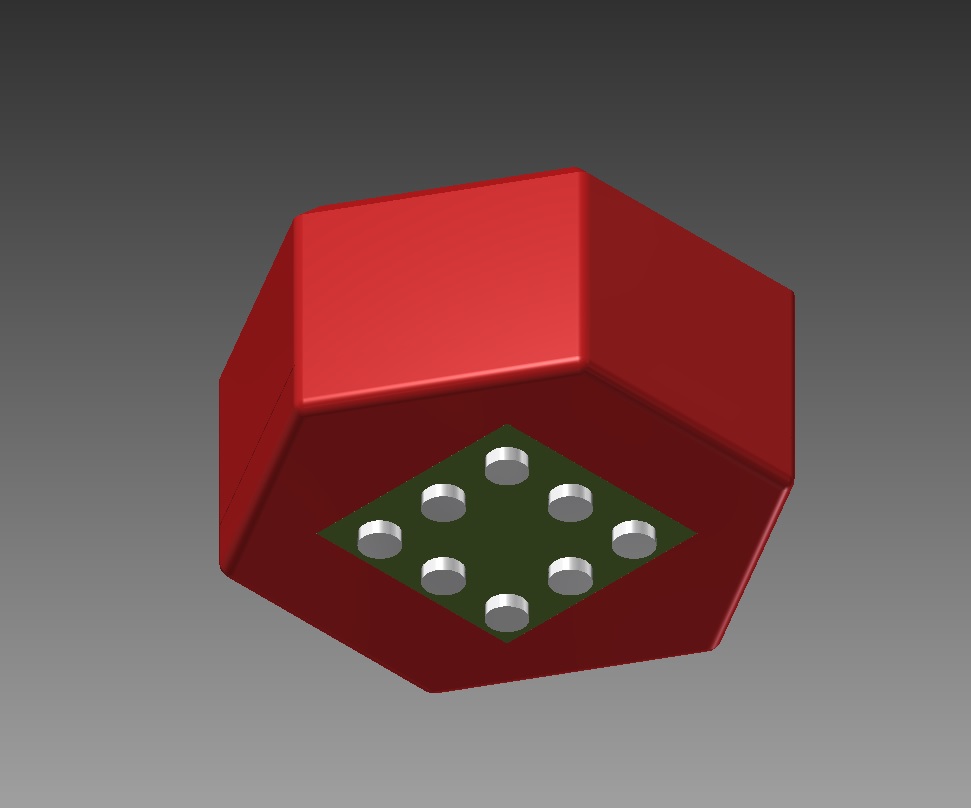
LED bottom
I finally made a proper initial render of what this lighting system could look like.  Both as a single light source and grouped together.  The 8 points on the bottom of the Sub lighting element are one approach to the lighting systems power and communication contacts, with a similar chip element to what is found in the thunderbolt connector type (found in devices like the iPhone) it won't matter which way the lighting element is plugged into its power supply, the lights will work)  On the top you have 7 LEDs they will provide light as well as a means of diagnoses, depending on how many LEDs are illuminated and in what pattern, users will have a means of determining where power issues are occurring, when a module is nearing the end of its life, or other information.  Aside from the full on and full off values, the bulb could potentially have over points of data that could be communicated, assuming you don't worry about rotational symmetry.
LED top.
 
As I refine this idea I can add more details, as well as better models.  The critical question is maximizing functionality while keeping per unit costs as low as possible.  Additional questions on thermal performance of the bulb configuration are worth investigating.
Multiple lighting elements grouped together/


Saturday, October 10, 2015

Sustainable Water Towers

Water Towers are an impressive feet of engineering, allowing municipalities and buildings to maintain relatively constant water pressure throughout the day.  Awesome concept, what I wonder is why aren't these water towers doing more, there is plenty of available surface area that the water tower provides for green energy production.  Additionally the tower's height already provides much of the altitude gain that a wind turbine would need to ensure maximum energy production.  For municipal applications I could see concerns about liability or aesthetics, but for smaller use cases a water tower working in tandem with renewable energy sources would make a huge difference.
Imagine a traditional water tower 30-45 feet tall, providing water pressure for an off-grid house.  Rain water is collected in lower tanks, and when the home's energy production exceeds use, water is pumped up to be stored for later use. 

A more complicated use solution would integrate a range of technologies, solar panels, wind-turbines, and that really cool transparent blackbody material.  The solar panels would be on the side of the tower, the rational for the solar panels being on the side of the tower are two fold, the added height reduces the potential for the panels falling into shadows, and the mass of water behind the solar panels would minimize overall thermal fluctuation.  On the backside of the tower would be a passive radiator solution, intended to avoid direct exposure to sunlight, hopefully maximizing the passive cooling ability.  On top of the tower would be the wind turbine(s), while this does add another element that requires maintenance, the increased reliability of power production for an offgrid solution should make it appealing.

10/11/2015 (I'm taking a break from finishing this article as it is 1 AM and I should try getting some sleep

Monday, July 29, 2013

Re-using Waste in Forward Operating Bases

One of the many unsexy challenges facing servicemen and women deployed in nations like Afghanistan is the disposal of the incredible amount of material waste that deployments produce.   Many smaller Forward Operating Bases (FOBs) are relegated to simply burning their waste, ranging from packaging material from care packages, to unneeded paper products, and, some of the least pleasant, human waste.   What I would like to propose is a technology that might aid in reducing the problems associated with waste disposal on a FOB.
Rocket Stoves are considered one of the most efficient means of utilizing traditional fuel sources, including, wood, grass, and dung.  The objective is to develop a product design envelope for a rocket stove that works in multiple ways to help manage waste production in remote areas.  In Figure 1 is an simple example of a rocket stove.  Fuel burns in the combustion chamber with the smoke from the fire being pulled into the larger volume chimney, the placement of the chimney promotes strong air flow aiding in the burn process, the lay out also allows for greater use of the energy produced by the burn.  (the red lines show the path of air through the system)

Figure 1:  Basic Rocket Stove
The high temperature burn produced in the combustion chamber of a standard rocket stove is most likely enough to promote a cleaner burn process than an open pit burn more can be done.  According to a 2010 US Army Corps of Engineers report the average warfighter will produce roughly one third of a pound of waste per day.  Often human waste is what is being disposed of in open pit burns.  The platform shown in Figure 2 is a preliminary concept for handling human waste.


Fig 2:  the modified rocket stove design
The first major change you should notice between Fig 1 and Fig 2 are the red radiator pips now surrounding the chimney segment of rocket-stove, the purpose of the radiator pipes is to allow personnel to take greater advantage of the thermal energy produced by the stove.  In this particular approach I assumed that the quality* of the heat produced by the rocket stove is not great enough to warrant a fully fledged steam generator .  Based on my assumption about heat quality I suggest that between the radiator pipes and the chimney section would be a network of thermo-electric generators (TEG), making the platform a true co-gen system.  The heat that is carried away from the chimney system allows for a maximum delta T, improving the performance of the TEG, this waste heat, while of a lower quality still has a great amount of value, I will emphasize the nastier sounding narrative that I believe has the greatest use.  After absorbing sufficient thermal energy from the rocket stove the working fluid will need to transfer its heat somewhere, that somewhere could be the dehydration of poop (sorry I wanted to say that for ever and this isn't a fully professional document so work with me).  Boiling water, as many home chocoletiers know, is one of the most effective ways to keep a temperature constant, human waste contains an incredible amount of water.  As the intent of this design is to reduce smell it would be silly to try dehydrating the liquid waste in an open environment consequently the dehydration chamber's off gas would be pulled into the air intake of the combustion chamber, causing the materials to be combusted into less noxious component materials. (I hope)  After the waste has been dehydrated enough it can now be more thoroughly disposed of by being utilized as a fuel source.
(I need to insert a thermal diagram of the cooling deal)


*Energy Quality relates to how easily you can get energy to change from form A to form B.  In the case of boiling water you've already changed the form once and to said steam into electricity means you are going from B to C, doing this by means of a turbine generator, is most likely not possible.

** I totally forgot to note the suggestion of having TEGs and a heat exchanger in the exhaust/intake section of the design.  Darn.  At least one other Alaskan likes the idea of a TEG in a stove exhaust.

This post was originally intended to be a section on suggesting my own take for developing a rocket stove for rural communities that would serve as a hot water heater and electrical generator for homes.  For whatever reason the narrative of a co-gen platform at an FOB felt easier to write, but both applications are viable, the only difference would be the statistics and sources I referenced.


Thursday, May 16, 2013

Reflected Light Nano Materials and Better Solar Panels


Fig 1:  Albedo Values of materials
Source: http://en.wikipedia.org/wiki/White_roof
                    Human built environments have a nasty habit of becoming too hot in the summer time.  A combination of materials that love to convert visible light into heat, large blocks of materials like concrete retaining said heat, and air conditioners dumping their heat into the air around residents.  One solution for mitigating the thermal gain of urban environments is to increase the albedo, or the ability to reflect sunlight (this should not be confused with libido).  Increasing the albedo of an area can be done in a myriad of ways the most popular being painting rooftops a reflective color such as white.  An extremely cool (no pun here) version of the white roof has been developed by graduate students and faculty at Stanford University, they have created a material made out of intricate nano-structures that pull double duty for cooling.  First the material works as an extremely reflective material increasing the albedo of the region that it is placed.  The second and by far more sci-fi sounding feature of this composite is that it is designed to emit thermal radiation in a frequency that our atmosphere is generally transparent to (for people who like thermal dynamics this is really impressive.)

                Other members of Stanford's faculty believe that it is more worthwhile to install solar panels, as the solar cells are generally more reflective than traditional black tar rooftops found on many large buildings and allow for electricity production.  To them I ask ----------------------->

             Recent research has indicated that the snows of winter can actually improve the performance of a solar panel, so long as it isn't covered in snow.  The snow acts as a reflector concentrating more sunlight onto a solar panel, while the cold temperatures of winter can increase the overall efficiency of the system.  Merging this thought with the properties of the Stanford nano-material, which I will call Silver-Surfer for the remainder of this post, one potential design solution came to mind.  Place a solar panel on an easily mounted structure that has Silver-Surfer placed in such a way to suck heat away from the solar cell and reflect a certain amount of incident radiation back towards the solar cell.
Fig 2:  Straight on view of Collector Reflector
The initial configuration would operate as an angled trough with the solar cell at the bottom and Silver-Surfer angling out in such a way that the reflective/emissive surface is maximized without interfering with the ability of the panel to gain sunlight.


Figure 3: Θ and the panel
One critical consideration, if this approach is considered a rational choice, would be determining the angle at which the solar cell and the Silver-Surfer are mounted relative to each other (assuming a non-tracking array). Figure 3 Highlights the angle of interaction, in the case of the quick model Θ (theta) was set at 30 degrees arbitrarily.  The actual angle would be a balancing act of potential shadows cast during day time operations (particularly early morning and evening), increased solar reflection onto a given area of solar panel, and cooling benefits as a result of the area of the Silver-Surfer sub assembly. The trump considerations, deserving their own sentence, would be the impact of cost of materials, installation, and maintenance.  A lower theta value would most likely indicate a lower life time cost of operation relative to net energy production/savings.

Fig 4: Panels on roof top
As an installed platform the array could look something like figure 4, where the collectors create a direct route for precipitation to slough off.  Placing the panels horizontally is possible and may make sense in regions with accommodating climates, it would also allow for the panels to have much larger theta value, increasing the cooling surface.  Other panel orientations should not be ruled out as they could find a sweet spot between dealing with local weather and maximizing the cooling energy generating/saving potential of the system.

One final note, it should not be ignored that in addition to working as a passive generating platform there is the potential for adding piping or ducts into the system.  During the day the system would most likely operate in a similar fashion to the more passive design suggested above, but at night the Silver-Surfer elements could be used to help chillers to produce ice to further offset day time HVAC needs.  This kind of approach would be targeted at facilities like server farms that tend to produce tremendous amounts of heat, even before thermal gain is considered.  Domestic installations would be unlikely to benefit from a more active system as the Gizmag article on Silver-Surfer stated that an average 1 family 1 floor home could achieve a 35% reduction of air conditioning needs by installing Silver Surfer on 10% of the area of a house's roof top.

Wednesday, February 20, 2013

An Alternative to Salting Sidewalks(?)

One of my less testable ideas for sure, but during my dog walk this afternoon I saw again how much discomfort salting streets and sidewalks causes our four legged friends.  The general idea would be some kind of non-toxic biodegradable material, that during the day time becomes some color that will convert as much solar energy into heat as possible, while not being aesthetically unappealing.  At night this material would magically become transparent, to reduce the potential for ice formation.  

Thursday, November 8, 2012

Cooling with Hot Water Heaters

Solar hot water heaters are considered one of the most cost effective ways to add a renewable energy source to a home or business. Another way to decrease your energy bill is to take advantage of technologies that consider the cost of energy as a factor of the time of day, one approach that does this very effectively is the production of ice at night to aid in cooling during the day.   (wow this is feeling like I'm writing a report for 9th grade science, but darn it I have no better intro coming to mind)  Several months ago I asked myself if it might be possible to find some kind of synergy between these two technologies.  

For engineers and people who understand my ADD I will provide the quick and dirty thusly immediately below.  As I have time I will add explanations at the bottom, or as requests for clarification come in.

Figure 1
The concept I am presenting here is based on the fact that optimal cooling systems are as close to black body ideal bodies as possible.  The collectors in a solar hot water heater have a relatively large surface area and are painted to behave as a black body.  Traditionally this trait goes unused for half of the day, what I am curious to see, is would it be possible to utilize the black body characteristics for night time cooling, most critically would it be cost effective to utilize the configuration I propose or something similar to it?
To minimize cost, the design shown Figure 1 utilizes a single hydraulic pump and a flow switch that alternates between the two heat exchangers.


Figure 2
  As day turns the night the characteristics of the system will change in a few critical ways.  First and most obviously the flow switch will alternate from having the working fluid move past the Water Heater to the Refrigeration Radiator Augment (yeah I know the name isn't sexy, I'm an engineering geek not a marketing guru, whaddya want from me?) The altered configuration is shown in Figure 2.  For the system to be used as an effective additional convection and black body radiation cooling surface, to augment the standard radiator found on refrigeration systems, the body design will need to under a range of potential configuration changes.  With respect to radiative cooling, the insulation layer that is so critical for day time operation must have the ability to either dynamically alter its thermal resistivity or physically rearrange itself to allow for maximum exposed surface area to the ambient environment.  To increase the overall efficiency of the system convective cooling should also be considered and a design that promotes both active and passive air flow, at night, could drastically alter thermal performance.  One potential approach is roughly shown in Figure 3
Figure 3
 What Figure 3 attempts to convey is that, warm working fluid is piped up through the base of the cooling system, which has expanded itself to aid in nighttime reverse energy transfer.  The glass covers which kept heat in during the day are now open to the night and letting infrared radiation and warm air escape into the night, additionally fan(s) might possibly be used to promote forced convection to aid in the cooling process.  One way to power the fan system might be to utilize some kind of thermal electric generator to minimize the system's energy demands.

Overall I am really curious to see whether or not a design like this would actually be more energy efficient than using the two technologies separately.  The solar hot water characteristics are rather known and the financial models for the technology are readily available and the cost analysis of implementing an HVAC system that utilizes night time cooling can be done by any number of contracting agencies.
       
               The real questions for the system's theoretical synergy stems from the fact that heat syncs experience diminishing returns on their ability to transfer thermal energy. Would this system only be considered beneficial if it was manufactured as a single platform, reducing the amount of radiator surface area built into the actual AC unit?  Could it be utilized as a way to augment existing systems as a way to lower energy costs?  While I can put together the basic equations I unfortunately don't have the resources to do an in-depth analysis on the potential ROI if there is any.  Realistically I  have my own doubts about this concept, no matter how cool I think it is, simply put there are too many moving parts that need to be factored in to the system's design and sadly moving parts/having more parts generally = greater overall cost.  Anyways I hope this at least gave you something to think about, please feel free to provide your own input.
The basic concept of a solar hot water heater is relatively straight forward, a number of pipes are coated in as dark a material as possible, the closer to true black the better.  As sunlight is absorbed by the pipes the energy of the light is converted into heat energy.  This heat energy is transferred to some kind of carrier liquid, with respect to what I will be describing this liquid will be any material that will not freeze or boil within the temperatures normally seen on the Earth's surface (-70 F-250 F).  The carrier liquid will move from the heating pipes through a pump until it reaches the heat exchanger, at the heat exchanger the warmth from the carrier liquid will be used to pre-heat a water source, before that water goes into a hot water heater.  After the heat exchanger the carrier liquid is cool enough to be cycled back towards the hot water heater.