Showing posts with label Consumer Products. Show all posts

Thursday, March 31, 2016

The Passive Aggressive House

Modern home building designs are beginning to focus on ways to make homes as energy efficient as possible, from better insulation, to thermal pumps, low flow toilets, solar generators.  These innovations are doing wonders to reduce humanity's impact on the environment, yet they could go further.  Humans are the weak link in home designs, with this realization Smart Home Innovation and Technology Tomorrow and Yesterday (SHITTaY) has come out with a complete product portfolio for creating the very first passive aggressive house.  The passive aggressive house is a wondrous convergence of machine learning, smart sensors, and proprietary technologies, working together to guide residents to a more sustainable life-style.  Each door and window has a sensor noting when the door was opened and the ability to ask itself "did someone really need to leave me open for that long? (I mean they're wasting all of this power trying to heat the outside)"  if the answer is that the door or window should have been closed sooner, the passive aggressive house will politely leave a sticky note on the offending door the next day, reminding the user how much energy they wasted.  Light-bulbs have similar concerns, should they have been run as long as they were, could the user have gone to a brighter spot in the house? if power was wasted users will get a snarky text, several hours or days after the offending action, asking the home owner to be smarter about when they use a light.

The wonders and innovation of SHITTaY don't stop with energy management, the passive aggressive house is deeply concerned about your health.  Networking with smart health and activity monitors, the passive aggressive house knows how much exercise you have done in the past 24 hours and will comment on your snack selections accordingly.  Did you miss your step goal for the day? Not a problem the passive aggressive house will leave judgy messages on your refrigerator's smart display custom tailored to your snack selection.  And if the house feels you really should eat a healthier snack it will push your chocolate eclairs to the very back of the fridge and let them rot there.

Developers at SHITTaY are working tirelessly to provide more natural language interface with the passive aggressive house.  Currently the system is limited to text based interaction, but in the near future the company hopes to integrate actual spoken interface, with voice options including, Fran Drescher from the Nanny, Gilbert Godfrey, your annoying ex, and if research goes well a modulated version of the user's voice from when they were going through puberty and having their voice crack.

The tomorrow's of tomorrow are that much more exciting thank's to the research from the SHITTaY team.

Happy April 1st everyone.


Friday, January 15, 2016

Blu-Ray/DVD features I want in the Deadpool movie

Dear Marvel Studios,
When you release Deadpool on DVD, can you have an easter egg where when you pause the movie at certain scenes, Deadpool starts moving from the action after several seconds and starts talking to the viewer.  That would be delightful.
Yours Truly,
A Fan

Wednesday, December 9, 2015

Flat packing the critical parts of a home

Providing sustainable living arrangements for a burgeoning global population is a tough proposition. Engineers around the world are asking themselves how do you bring the most benefit to the world without draining its resources?  Housing has an amazing potential to impact the overall level of sustainability of a region, the more efficient a community is at using its local resources the lower their ecological footprint.  One way to make homes more efficient is to provide home makers with an efficient starting point for construction, to that end designers could work to create construction elements to serve as that starting point.  It is my opinion that these starting points should be the kitchen and/or the bathroom.  The rational for these rooms serving as the starting point stems from the additional mechanical complexity required for rooms that have plumbing.  If someone building a home had a wall that contained all of the necessary elements for moving water, electricity and if needed natural gas, the cost of building the home should be drastically reduced.  At this point I have an under constrained design space, which can be rather overwhelming as you start to consider so many different possibilities.

Possibility 1)  A really bare bones system with connection points for water (hot and cold), electricity, and drainage.  This provides a strong starting point that you could attach either a kitchen sink or elements from a bathroom.  Possibly the cheapest of the concepts.

Possibility 2) A total of 3 wall segments folded into a single flat packed element that allows for power and water distribution between the 3 walls, this would allow for builders to have a very easy starting point, that so long as it was unfolded along specified configurations, would also be rather stable, even before the rest of the house was completed.

Possibility 3)  Go more high tech and integrate electrical storage into the wall elements, helping to smooth the home's energy demands, varying tiers could be designed for different budgets,   The intro model ships with a 200 watt solar array and embedded into the walls enough energy storage capacity for 1 kilowatt hour of electricity.  Not a large amount of energy, but it would allow for the lights to stay on during power outages.  Higher tiers could store more electricity and provide for larger electrical draws.

Possibility 3 b)  Integrate additional lighting fixtures, considering modern LEDs are expected to have life expediencies of around almost 20 years, with some clever design work you could make a home where the lights wouldn't need to be changed for generations.  (there are some trade offs that may make this a terrible idea, but hey, we're talking theoreticals now)

The rational behind designing individual wall elements with all of this integrated equipment as opposed to creating a flat pack home stems from the belief that this technology should be used to empower local communities, not mitigate the benefits of local labor and resources.  With these panels, home designers could choose to make something akin to an Earthship, a more traditional American Cape-Cod, or a home design whose name I don't know.  Ideally such designs should be open source or at the very least, like shipping containers, there should be standardized dimensions and design constraints to ensure safety.  Examples could include making sure the wiring and socket elements can accommodate the various AC standards found around the world.

Monday, November 16, 2015

Modular Home Lighting

I meant to write this post awhile ago, and the ideas are a little disjoint, but I would like to get something out there.

Home lighting in developing countries is a huge economic bottleneck, too many households need to focus on solutions that are low cost in the short term, even though the long term costs are much higher, things like candles, kerosene lamps, or battery powered flashlights.  Any number of NGOs and for profits have worked to develop a range of lighting technologies that will help make the home lives of their users better.  One potentially new concept to promote these lighting technologies is designing a product that can be equally at home serving as the very first electric light-source that person has ever used or as the lighting solution of a modern home.  This can be done by rethinking the LED lighting solution, the vast majority of home LED solutions take advantage of the 100+ year old Edison screw design, this makes sense if you are utilizing older infrastructure, but we are in an era where design rules are changing and there are new connection standards that can make more sense, for example the USB 3.1 C standard.  This standard will soon be ubiquitous across almost the entire planet, and unlike the Edison screw, the voltage and amperage characteristics will be equally consistent from nation to nation.  Engineers could work to create lighting elements that distribute power via USB cables and connections types, and to avoid overloading the power distribution capabilities of the cables, bulbs could be designed to include simple communication protocols that would warn users of low power, excessive draw, etc...

11/16/15 my brain is a little disjoint right now but I wanted to get this idea down. Broad strokes, create an open standard that uses a smart connection type, it doesn't have to be USB 3.1C, but honestly it makes the most sense with that hole 100 watts of power transfer range and what not.  Lighting modules don't need to be exactly the same, but they should have some minimums, shared micro-controller standards, simple and standardized power requirements, easy thermal management, basically if lighting unit A is next to B in normal operating temps, they should stay fine, without any external cooling system, a way for bulbs to efficiently distribute power across bulbs, think femto electrical grids.

The entire rational of this design is that if a community invests in this lighting system, as money becomes more available they can improve their solution, going from small lamps to more traditional overhead lights, all while up-cycling the original components of the small lamp.

11/20/15
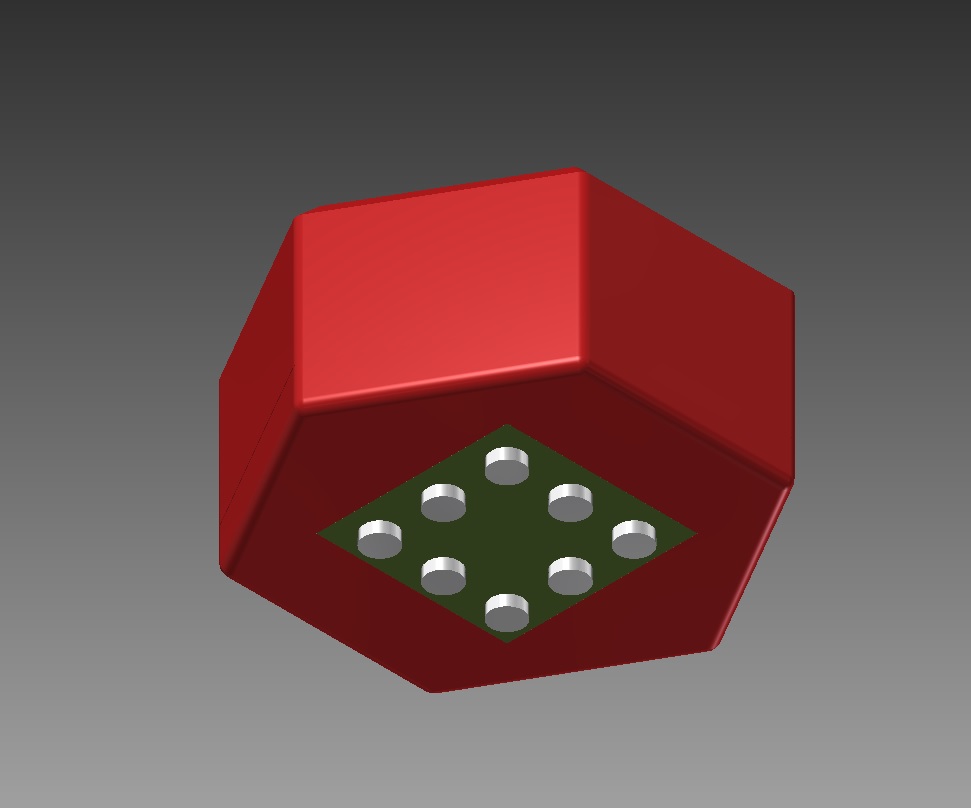
LED bottom
I finally made a proper initial render of what this lighting system could look like.  Both as a single light source and grouped together.  The 8 points on the bottom of the Sub lighting element are one approach to the lighting systems power and communication contacts, with a similar chip element to what is found in the thunderbolt connector type (found in devices like the iPhone) it won't matter which way the lighting element is plugged into its power supply, the lights will work)  On the top you have 7 LEDs they will provide light as well as a means of diagnoses, depending on how many LEDs are illuminated and in what pattern, users will have a means of determining where power issues are occurring, when a module is nearing the end of its life, or other information.  Aside from the full on and full off values, the bulb could potentially have over points of data that could be communicated, assuming you don't worry about rotational symmetry.
LED top.
 
As I refine this idea I can add more details, as well as better models.  The critical question is maximizing functionality while keeping per unit costs as low as possible.  Additional questions on thermal performance of the bulb configuration are worth investigating.
Multiple lighting elements grouped together/


Thursday, October 22, 2015

The Gourdinator

Hey you! Yeah you!  Do you have an excess of pumpkins, squash, and other gourds?  Then you need the gourdinator.  The gourdinator turns your pumpkan't into a pumpkan. (there is a reason I should never write dialogue for actual consumer products) Using sophisticated 3-D sensing systems and a multi-axis CNC machine, your gourds will be transformed with designs ranging from a traditional Jack-o-Lanterm to the face of alien creations out of your child's nightmares.

This idea was inspired by various companies that CNC their pumpkins during the Halloween season.

Monday, July 27, 2015

Window Heating Units

As an Alaskan transplanted to the New England area, my battle with the summer heat has been a constant uphill struggle to find some kind of happy medium to keep my core temperature from becoming entirely unpleasant.  My current solution has been to have a window AC unit at home set to as close to glacial as physically possible.  Come winter I have a different problem of not wanting to spend excessive money on keeping my apartment warm.  In an ideal world my residence would have thermostats in each individual room so that my bedroom was toasty, the living room pleasant, and if I magically had any other rooms in the space they wouldn't be huge energy draws.  In a more realistic version of reality getting a rented apartment to have a highly granular zoned temperature control is unlikely, so how is a renter to reduce their apartment's heating costs.  REVERSE AIR-CONDITIONING otherwise known as "Air Source Heat Pumps" can be used to capture the thermal energy of the outdoors (yes, if it is above zero degrees Fahrenheit, possibly colder, you can harvest thermal energy from the ambient air).

Currently there are a range of these heating systems available for general consumption, but none of them, according to my ten minute web search, are designed to be seasonally added to a window sill.  The benefit of this could be huge, instead of home owners buying incredibly inefficient heating element style home heating systems, consumers could buy a smart window unit that would capture ambient outdoor energy.

 Design challenges would be great, but not insurmountable. The total cost of the unit would need to achieve a reasonably short ROI, preferably less than three years, ideally less than one.   Cost consideration is where a clever business plan is most important.  Depending on the actual material cost of this system home-owners might balk at the up-front cost and not buy in, regardless of long term saving potential, so how do you get people to invest in a long term money saver, options include but are not limited to a model similar to roof top solar companies that rent your roof space and sell you the power.  The window heat pumps would not be owned by the home owner, but by a leasing organization, where the home-owner/renter simply buys the hot air from the company (some political joke here).  Power producers that identify customers who use electrical heating in their space could provide financial incentives to offset the cost to the consumer.  The window system would need to weigh no more than that of a currently available window AC unit that consumers would use in the summer.  After cost and weight are accounted for in the design, ease of use and ideally overall attractiveness of the design should then be accounted for.

Down the line dream features, the system can change which side it is pumping heat to and from, cooling in the summer, warming in the winter.  Connectivity to smart home systems, allowing the unit to know when to crank up the heat, ideally it could work with other systems in the home in concert, allowing for finer control of home energy use.

An alternative technology that I am unsure if it deserves its own post, so I will write it down here for the moment.

Smart blinds and curtains.  Windows can allow for a large amount of thermal energy to enter or escape the home, even well insulated windows can allow the energy of visible spectrum light to come and go as it pleases.  Well designed window coverings could offset some of a home's energy use (I'm going to need to look into that particular number 7/27).  On hot days in the summer, when no one is home, the smart blinds would lower a white and or silver curtain intended to reflect away excess sunlight.  In the winter the blinds would lower a darker covering designed to convert the visible energy of the light into thermal energy that would go into the house.  A very simple version of this system would use a small solar panel to power itself (or plug if need be) and use two types of curtains, one black one reflective to cool the house.  More sophisticated versions would use either smart materials or several layers of curtain material to give finer control of the amount of light allowed in and energy converted.

links for me to embed later http://energy.gov/energysaver/articles/air-source-heat-pumps
http://energy.gov/energysaver/articles/heat-pump-systems


Thursday, July 23, 2015

The FreshStart Phone

A few days ago a friend of mine texted me asking about how hard it would be to embed solar panels in a low cost cellphone, so that individuals who for whatever reason were trying to get established, would have some way to communicate with their healthcare provider, parole officer, who ever they needed to reach out to to get back on their feet.  The core sentiment is an excellent one, provide a resource for those who are at the greatest risk to engage with society, my primary point of feedback was the power output of the solar panel.  Even under the best circumstances the available surface area of a cellphone would have a hard time collecting enough sunlight to conveniently charge a cellphone.  (I may do the math showing this later, but for the moment I am just going to keep the work conceptual)
Just because a cellphone would have a hard time being charged by sunlight does not mean we as a society couldn't create a device that would be truly useful to those less enfranchised.
Whatever design that is eventually developed it will need to meet a rather challenging list of constraints.  The design suggestions I am putting forth below are just one way a product could be designed to meet a user's needs but I feel it would represent what individuals  might desire in their smart device.  My temporary title for this phone is the FreshStart, if someone in marketing wants to change it, great, I never said I was great at naming things.

The biggest limiting factor is cost, no matter how you want to slice it the primary customers of our starter phone are not the end users, but organizations that need to be able to buy hundreds, if not thousands of devices without destroying their budget. While I have no idea how much per unit either the governments of the world or non-profits would be willing to go, I am going to assume that these phones are being distributed in countries like the US and as such a maximum price of $50 is far from unreasonable.  Current Nokia feature phones cost something like $30 so it shouldn't be that unreasonable to keep the dollar cost of the device close to that.

After cost comes reliability, the device needs to be physically tough and have a very high endurance.  Users may not be guaranteed the opportunity to charge their phone every day and so the battery capacity should reflect the need for going several days without charging.

Close after reliability is attractiveness of the device, users need to feel like the phone they are getting is something important and worth holding onto, it may be free to them, but it should also be something that they value for more than the phone calls.

So far I am reasonably describing currently available feature phones, many now have very excellent run times, so long as they are only used for calls and texting they can work for days. Personally I enjoy the simple look of the Nokia style brick phones (this could be a result of early 2000's nostalgia.)  What would be a distinguishing characteristic of the design is integrating the charger, the majority of phones require you to have a second piece of hardware to charge your phone.  By integrating  the charger you are reducing the number of things someone has to keep track of.  The FreshStart's back would have a simple two prong A/C connector that would allow the device to be directly plugged into a wall  outlet.  To compliment the A/C adapter and to acknowledge the fact that individuals are mobile and may not have a long period of time near an outlet, for example the time it takes for them to finish their coffee, the FreshStart would have part of its battery capacity be a non-removable high endurance rapid charging element, either an ultra-capacitor or an optimized breed of battery that I can't think of right now.  This batter would be intended to charge in under 2 minutes while providing enough energy for ten times or more run time, ideally several hours of use.

Additional features that would be nice but not required, built in USB ports to allow other devices to charge while the phone itself charges, a USB plug to allow the use of charging ports that are now showing up in cities, a flashlight, an E-Ink display.

As of now this is as far as I've gotten with the FreshStart's concept, when I get back to my desktop with CADsoftware I will try to create a 3-D render.


some follow up links, here is a case for the Iphone 5 that has the charger in built as suggested http://www.amazon.com/Prong-PocketPlug-Case-Protective-built/dp/B00F0X1JUC
 and here is where I got the Nokia price point
http://www.pcworld.com/article/2865184/microsofts-29-nokia-215-is-a-smarter-feature-phone-for-the-masses.html

Tuesday, July 14, 2015

Dear Electronics Manufacturers, Stop Keeping Me Up at NIght

Years ago I recall reading an article noting the reason why electronics devices have bright LEDs is that manufacturers want consumers to pay more attention to their product on show room floors, but most of us don't live in a showroom, so why do the LEDs remain at the same brightness?  Honestly, I'm going to blame some corporate marketing genius, but I HAZ SOLUTION!

Photo resistors, that's right, simple photoresistors.

Manufacturers could readily embed one or more micro light sensors, that would provide feed back into the power supply of any visible spectrum LEDs.  Using a relatively simple PWM on the power of the LED, your device could dim its lights in real world conditions but still be annoyingly bright on the showroom.  

Unfortunately the reason technology like this isn't implemented isn't a result of lack of technology, it's a result of lack of incentives for them to make this feature common place.

7/15/15 Follow Up

Option B, instead of using circuits that add to the cost and complexity of manufacturing electronics lighting, sticky pads.  Using the same style of adhesive that painters tape and Post It Notes (tm), make pads of material that are designed to cover individual LEDs.  A company could make a generic pad that covers a given area, read a square of material, or you could get customized pieces that more closely match a given device.

The reason for this, I hate putting pieces of tape on my electronics, but it seems like it is the only way to ensure that my bedroom isn't a damn glow cave

Monday, July 8, 2013

Augmented Back Pack and Other Clothing

During an evening of booze and hockey in the background my friend Andrew and I started to chatting about  an idea for a hackable smart backpack intended to move the backpack from a passive container to a dynamic tool.

In an era of ever cheaper tools for embedding smart tools into watches, glasses, and t-shirts why have backpacks generally been left out of the realm of innovation.  The HackPack would serve as a dynamic platform for makers and users to have access to smart tools.  The minimum components in the HackPack would include an onboard battery, computer or microcontroller capable of bluetooth communication, and readily accessible ports for distributing data/power.  The key feature of the HackPack package is the ability for the tools of the backpack to communicate with smart phones and other devices. The basic kit could be made into a small package according to set standards and intended to augment existing backpacks.  A more consumer friendly version of this concept would come pre-built with a collection of sensors and displays to communicate with the owner.
Figure 1

In figure 1 you see a visual outline of what the HackPack's exterior could feature.  The red lines indicate the placement of EL wire intended to display simple information, ex. someone going for a bike ride at night could have their changes in direction displayed by the character display on the back.  The lights on the strap could be used to alert the user of useful information about the state of the HackPack, whether they have an appointment, etc..  In the side view of the HackPack there are 3 blue squares indicating where vibration pads could be placed in the straps of the back pack.  The pattern and intensity of the pad's vibration would communicate any number of set messages, ranging from telling a hiker where they should be looking for their next course correction, to working with a social networking app to let you know a friend is nearby.  The straps should also have simple button pads to allow users to communicate with the on board micro-controller with out requiring access to an additional tool.  These basic features would be complimented by a collection of attachment points placed on the exterior and interior of the backpack, allowing users to add speakers, electrical generators, environmental quality sensors, the limits would be the imaginations of accessory engineers.

The Spec sheet for this backpack would look something like this

On-Board Computer:  Arduino micro-controller with bluetooth shield, Rasberry Pi computer
Battery Pack:  Capable of keeping computer and accessories online for at least 24 hours and charging a standard 2100 mAh cellphone battery at least 2 times
Communication Points:  USB or 3 wire PWM compatible
Weight: 3 lbs or less for all basic kit components

Additional attachments could include.
Infrared communication system for laser tag and mesh networking
Geiger Counter
Wirelessly accessible hard-drive
Speakers
Electrical generators
Moisture Sensors
Video Camera
Projectors
RFID/NFC sensors for keeping track of interior elements (this idea was taken from here)


http://www.kickstarter.com/projects/phorce/phorce-the-worlds-first-smart-bag
battery and tells you how much battery life is left via bluetooth

http://www.talk2myshirt.com/blog/archives/4197 weight sensing pack

http://gajitz.com/green-to-go-sustainable-multi-talented-electronic-backpack/ artsy fartsy deal

http://www.ubergizmo.com/2010/05/aniomagic-weight-sensitive-backpack/ weight sensing

http://www.treehugger.com/renewable-energy/energy-generating-backpack.html energy generating backpack

http://www.treehugger.com/gadgets/rechargeable-led-backpack-totes-your-stuff-keeps-cyclists-safe.html  illuminated pack

http://www.digitaltrends.com/lifestyle/new-smart-clothes-will-be-able-to-adjust-to-your-moods/ smart clothes

http://thinkmag.net/think/tag/smart-clothes/ more smart clothes

http://healthinformatics.wikispaces.com/Smart+Clothes

Cool Ben Heck design hack for making a turn signal backpack attachment
http://www.engadget.com/2013/07/30/ben-heck-bicycle-turn-signal/


Smarter Jacket
Dynamic EL wiring that "knows"  when the user wants to be seen and when not

bluetooth accessible for easy finding

Saturday, June 29, 2013

Bag Bowl Water for your Dog where ever you need it

Making sure your pet remains well hydrated on a hot day can be a difficult affair, doubly so if you want to pack light for a simple walk around town.  For those fortunate enough to live in neighborhoods that have pet watering stations this isn't much of a concern, for the rest of us, I suggest "Bag Bowl" (totally not TM).  The basic idea came to me while taking my sister's dog for a walk around the Boston Commons.  While there are water fountains it's a little difficult to get a 50 lbs puppy to the fountain's level and I think people would complain if the pup, Georgia, licked the fountain.  My temporary solution was to take a spare waste disposal bag and fold it into a shape that Georgia could drink from.  This worked rather well but it had some faults, namely the weird hand configuration I needed to fill the bag.  The "Bag Bowl" would serve as a light weight frame to support a dog's waste bag, unused of course, for when you wanted to fill it with water or food.  
(Drawings to come)


I realize that it would probably make more sense to have some kind of pouch deal that had a pocket for the poo bags separately, but I like the idea a bit when I came up with it this afternoon and wanted to update my blog.

Thursday, June 20, 2013

Knock off Nerf Idea

Fig 1 Nerf N-Strike Elite Rayven
Source:Hasbro corporate page
One of the minor frustrations of many traditional nerf gun designs is the potential for darts jamming.  While newer designs have added special access ports for clearing darts that have folded in on each other I felt it would be cool to put forth my own concept for a dart gun that eliminates the potential for jams and allows for easier reloading to boot.  Instead of utilizing the more common spring clip design used in toys like the Nerf Rayven (figure 1) this design would have each round placed in their own specialized chamber (fig 2)
(I will try to add some more details but right now I need to just get this out the door before I get back to job applications)
One of my favorite ideas in this design is the small magnets embedded in the pink side wall of the clip.  They serve as  way for whoever is using the toy to expand their clip as they are still firing their first clip.  During normal operation the magnets will keep the clips attached with enough force that normal jostling won't allow them to come apart and as each round is fired the next cell in the clip is chambered with the firing mechanism.  As the clip is pulled through and about to expire, a small amount of pressure is applied to the pink arms, forcing the magnets far enough apart that they upper clip can simply fall off.  On the right hand side of Figure 2 you will see the turquoise linear gear teetj that would allow for a worm gear to power the clips through the gun.
Figure 2
So while I like where I am going with this idea, I am going to call this a very basic early draft as there are about 20 things I would like to rethink/redesign for a system that would probably make a lot more sense

Thursday, May 16, 2013

The Ultimate Travelers Backpack

          Keeping track of chargers is a hassle, keeping track of your chargers while traveling can be down right maddening.  Avid travelers will worry about making sure all of their devices have the right charger.  Even if you bring all of your chargers with you, there is no guarantee that you will be able to grab one of the few outlets.  What modern wanderers need is a travel bag that keeps your chargers in a single location.  Current consumer brands like PowerBag are starting to fill that niche by providing a built in 3000mAh battery pack designed to allow for charging of USB devices on the go, what is missing is the ability to connect devices that might not have the ability to charge by USB.  The backpack shown to the right is an over engineered solution for a traveler's power needs.

          This design is intended to allow a traveler to internally charge 3 AC powered devices and 4 USB compatible devices. To bring power to the distribution system the backpack has a 114 inch extension cord built into the frame of the backpack.  Aiding in locking the cable is an external 3 prong outlet intended to allow the pack owner to share electricity with others.

         As this is a concept design, the backpack emphasizes flexibility over such silly constraints as reasonable weight and pack size.  The large brick at the bottom of the design is a stand-in volume to represent a multipurpose power supply, containing a battery for supplying power to the USB ports, a DC to AC adapter (intended to plug into a car electric outlet), and an AC to AC converter, to ensure the user can power their devices anywhere on the planet.

Monday, April 15, 2013

Hyper Rugged Cameras

One of my personal favorite consumer electronics genres has to be the rugged digital camera, when you're dragging yourself through mud, diving on a remote coral reef, what have you, this technology means you can cost effectively record your memories, totally awesome.  What is slightly less awesome is that the current approach to the ruggedized cameras doesn't go far enough to make them life proof.  The need to have access to the camera's battery and memory modules makes it necessary to rely on some type of ruggedized gasket to, hopefully, keep the elements at bay, a rather large point of potential failure.  In the era of incredibly cheap memory and wireless data modules combined with the adoption of inductive charging for home electronics we have a solution for a stronger camera.

Instead of selling a camera to home consumers where they must supply the memory card, why not have the camera have the memory capacity embedded, general consumers can already buy flash memory at well under $1/GB of storage capacity electronics manufacturers can comfortably add a large memory system to a mid-level compact camera without harming the bottom line too much.  Additionally when you look at developments to create smarter point and shoot platforms whereby photos can automatically be uploaded not only by WiFi but over cellular networks, it is surprising to see that integrated camera memory isn't exploited more.

The battery question is a little fuzzier depending on how a business wants to treat its target markets.  From the perspective of creating a rugged compact camera, having a removable battery causes more problems than it solves.  As mentioned earlier the ability to remove the battery pack requires an opening within the case of the camera that increases the likely-hood of moisture and dust coming into contact with more sensitive components.  Instead of a removable battery design the camera to have a built in inductive charging module, with wireless charging there is no need for the case of the camera to have any openings.  To allay consumer concerns about their inability to change batteries mid trip, product developers could compensate in a range of ways, making the camera as energy efficient as possible (this would minimize hardware costs over larger production runs), expanding the battery system to take advantage of the volume that would have been needed for housing a removable battery system, and finally (at least as far as I can think of) having some kind of solar/battery operated inductive charger unit sold separately (device manufacturers love this kind of thing anyways).  

Wednesday, March 6, 2013

Who doesn't want warm undies in the winter?

Considering the various needs of our global super elite why has dresser technology not caught up to the wonders of the 21st century.  Why don't we have dressers that make my boxers and socks toasty warm for when I wake up in the morning?  My solution, a smart dresser assembly with simple plug and play technology that is designed to allow users make sure their clothes come out at exactly the temperature they need.  Using a collection of sensors and heating elements each drawer could be programmed to optimally use available energy to heat underwear to the ideal temperature and minimize waste.  By utilizing a microcontroller capable of integrating with the home wireless network and preferably connecting with a cellphone you could get a pretty nifty solution going.  Networking with the user's cellphone over the wireless the system would be able to set the output temperature of the drawers to coincide with the user's morning wake up call.  Connecting the dresser's micro-controller to your home wireless network would also allow you to access it remotely, meaning if you need toasty sweats to put on the moment you get back from your cross country ski trip, well gosh-darn-it you'll get toasty sweats to wear.  One additional feature that I feel is still on the reasonable scale of things, integrating a small power strip and several USB ports for charging your various devices.

Now let's make this thing way more convoluted, let's add in LED lighting that goes on when you open a drawer.  And what's this nonsense about only heating my clothes, what if I want to wake up to ice cold boxer briefs in the morning or for whatever reason I want to use my dresser as an emergency mini-fridge well  why the hell not we're talking fantasy land technologies here.  
Adding RFID and NFC sensors would allow users to add tags to their cloths that could ensure that your fabulous boxer shorts made of only the finest alpaca fur never exceeded whatever temperature they should be heated to.

I will say that my idea at the basic form isn't that unique, I did rather quickly find a blog entry suggesting this idea, although their approach is based on a timing mechanism as opposed to an adapting control system.  One comment noted that you may not want to heat your entire underwear drawer, just the clothes you want to put on the next day.  An approach based on this suggestion would be a smaller smart drawer system designed to conveniently fit underneath your bed, although at that point of needing to plan ahead you might as well just put your clothes in bed with you the night before, way less cool. 

Monday, March 4, 2013

Playgrounds that play back and a rather Cynical business plan


This idea was inspired by Corey Doctoro’s book “Makers” and a conversation with Bill Unkel and JP Gonzales during my visit to New Mexico about a month ago.
In Doctoro's book "Makers" there is a short anecdote with in the story, where the author briefly describes a playground that is associated with a regional hackerpsace that is designed to adapt itself to children's playing habits.  Every night the playground recalls what elements were played with the most and rebuilds itself to make the environment as entertaining as possible.  During our conversation about this idea a range of joking and semi serious ideas came forth.  The most cynical version is at the bottom of the document (namely because I spent a decent amount of my flight home trying to get the ideas semi-coherent in my head and I don't want to completely waste the effort)  First and foremost is a kind of ideal.

Imagine a playground that plays back.  While Star Trek's magic holideck might still be more fantasy than reality we are developing technologies that can add extra dimension to play.  Surfaces that know what game children are playing and adapt themselves accordingly.  When a group of players decide to play no-touch-ground freeze tag the floor actually becomes lava, glowing an ominous red and when someone steps in the lava, a projected ripple in the lava helps with disputes on whether or not a person is out.  During games of hide and seek, the playground will first work to distract the person seeking out other players, but as the game continues it might start to highlight where other players are hiding themselves.  Slides that let you know how fast you were going down them.  For obstacle courses elements will begin to glow a specific color so that children have a clear idea of what path to follow.  Mesh projectors and screens could turn a pirate cove into a space ship at a moments notice.

A more extreme version might work with several mobile 6 axis robotic arms and elements that are intended to be dynamically connected, allowing park spaces to grow according to interest and need.

Based on the freemium business model of software and online games, anyone can use the playground, but only those who have paid for the services will get the various advantages (which are dependent on the tier of service purchased) Creating more interactive playgrounds that augment play experiences with visual modifiers, activity tracking, adaptive system game play, bully detection, emergency system response…(all extra features available for a small fee)…  GOD I FEEL UNCLEAN   
Under the most extreme parody of this concept you might even imagine facial tracking quad copters following non-paying users around shouting insults and jabs at the child who can't afford the platform

“Benefits” promoting physical activity in children, promoting healthy socialization of children, allowing parents to let go of their children (as the environment could be perceived as safter),  give parents something to talk about as they can discuss the various play features that they have decided to utilize

Using touch sensors, integrated lighting, projectors, mechanical actuators, visual tracking systems…. The playground is intended to promote play on the entire surface, all while allowing children to experience an acceptable level of danger.
As more sophisticated technologies become available it would be reasonable to assume that their might even be a premium on surface properties where they are adapted according to the needs of the paying users.

Disturbingly enough teater totters that limit their range when free users are on them, or parents restricting certain mechanics of the playground equipment.

Sunday, February 17, 2013

Making Homes Smarter, because freezing your ass off is no fun

During snowstorm Nemo I had the distinct pleasure of hanging out in a house that had to hover around 48 degrees to conserve heating oil.  A side effect of the apartment collectively forgetting to check our fuel levels until they were dangerously low.  During a walk home I was inspired by random thoughts to start sketching out a device that could help people avoid this issue happening.  The product I suggest is relatively straight forward as an initial platform, but with some revision could turn into quite a flexible home automation technology.  Connecting a low cost camera system to a micro-controller with a wi-fi or ethernet routing module would allow home users to place a smart device next to their home fuel meters to allow for automatic updates on their energy use.  In the rather crude drawing below you can see the sensor assembly placed near a fuel gauge with a plain background placed behind it (that is to help the camera read as readily as possible).

A really basic set up from a software approach to this technology would be to have a single piece smart package that customers would purchase.  After buying the package a customer would do a one time plug in set up where they connected their home smart sensor to any screened device with a USB port to provide a window for inputting information like, the name of the home WiFi network, network password if necessary, the user's email(s), and a specified frequency of how often they would like to be updated on system readings.  After set-up clients should be able to more or less ignore that their physical device exists and wait for updates on the systems operation.  As the necessary technologies get cheaper, users or service providers could even start to train the micro-controller to identify on its own when it would need to alert users when critical changes were happening to the system ex. fuel levels are getting critically low.

With the right APIs integrated into the system it would be possible to design the platform so that it would automatically order more heating oil (or whatever service it was connected to) from a designated service provider.  If the components became cheap enough it might be reasonable for companies like heating oil providers to distribute these smart systems to customers to allow for smarter predictions of service demand over time.  As the base system is relying on simple visual reads off of a webcam, it would be fairly reasonable to see later adaptations that made it possible to attach sensors like these to natural gas and electrical meters.  (I'm well aware of smart meters already in existence, the intent of this platform is to provide a way to add greater sensing ability to legacy hardware that might be too expensive to replace or not allow for retrofitting as a result of aesthetic/historic concerns)

Another potential application of a technology like this could be for management of liquid wastes like cooking oil.  Smart sensors in the grease collectors would allow collecting services to work automatically, increasing productivity and customer satisfaction.

Technology like this might help keep an eye on elderly family members while minimizing the invasion of privacy.  Concerned relatives could put simple sensors on the home heating, refrigerator, and some critical lights, the mesh could start to identify points of concern  (crap I think this originally came from Microsoft's smart home initiative, oh well)

Feb 1:  Well son of a be sting, it looks some MIT alumni have developed a very different approach to the idea I was proposing.  Their device apparently measures the energy performance of a home's heating system.  

Monday, November 12, 2012

Survival Flashlight

No survival kit is complete without some kind of emergency lighting kit, usually a generic LED flashlight.  While that's fine and dandy for most real world applications I decided to put forth my own pseudo idealized flashlight (the ideal model would have infinite battery life and cook me breakfast).  The general design is fairly straight-forward, 6 LED's, preferably clean white, an on off switch, a settings dial to allow for lower or higher lighting intensities.
To avoid being doomed by dead batteries the flashlight would be wrapped in solar cells, as the surface area of a cylinder does not exactly lend itself to a large exposed surface area for gathering sunlight, the solar panels on the grip of the flashlight, would be able to unroll as a sheet to maximize solar gain.  Many camping kits now come with any number of devices for charging USB devices and consequently I thought it would be prudent to add a USB port to the design.  Said port would be protected by the solar panels, when not being used for charging.  As so wonderfully shown in the cutaway drawing of the design, you will see both Li-Ion batteries in the frame as well as ultracapacitors.  The purpose of the ultracapacitors is to help regulate the energy demands on the standard batteries.  During the recharge cycle the ultracapacitors will aid in leveling out the characteristics of energy coming in, either from the USB port or the solar cells.  The ability for rapid discharge also aids in the most distinctive trait of this concept, the "LASER".  Starting a fire in survival situations can be a mind wrecking experience, especially if you cannot find your lighter or supply of matches.  The high intensity laser is intended to integrate your ignition source with your illumination source.  Rated at ????? mili-Watts (I need to do the math on what the energy transfer requirements) this laser can be pointed at a collection of kindling and cause it to ignite in under 10 seconds.  The triangular shape of the front of the flashlight is meant to aid in the ignition process, users can place the flash light on the ground next to the fire pit and be confident it won't roll around or move from shaking hands, ensuring the laser's energy remains targeted on the proper section of kindling.  Depending on the characteristics of available laser technologies, it might be possible to have far lower intensity settings for more pleasurable uses, such as identifying constellations while stargazing.